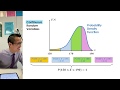
Discrete and Continuous Random Variables

Interactive Video
•
Mathematics
•
9th - 10th Grade
•
Practice Problem
•
Hard

Amelia Wright
FREE Resource
Read more
10 questions
Show all answers
1.
MULTIPLE CHOICE QUESTION
30 sec • 1 pt
What is a key difference between continuous and discrete random variables?
Neither continuous nor discrete variables can take specific values.
Both continuous and discrete variables can take any value within a range.
Discrete variables can take any value within a range, while continuous variables can only take specific values.
Continuous variables can take any value within a range, while discrete variables can only take specific values.
2.
MULTIPLE CHOICE QUESTION
30 sec • 1 pt
In the dice example, what does a relative frequency histogram represent?
The probability of each outcome occurring.
The sum of all possible outcomes.
The exact number of times each outcome occurs.
The relative frequency of each outcome compared to others.
3.
MULTIPLE CHOICE QUESTION
30 sec • 1 pt
Why is height considered a continuous random variable?
Because it is always a fixed value.
Because it is measured, not counted, and can take any value within a range.
Because it is counted, not measured.
Because it can only take whole number values.
4.
MULTIPLE CHOICE QUESTION
30 sec • 1 pt
What is a probability density function?
A function that represents the probability of continuous outcomes.
A histogram used for discrete data.
A table of all possible outcomes.
A function that shows the probability of discrete outcomes.
5.
MULTIPLE CHOICE QUESTION
30 sec • 1 pt
Why can't we assign a non-zero probability to a single value in a continuous random variable?
Because it would result in probabilities summing to more than one.
Because single values are not possible in continuous data.
Because it is not mathematically possible.
Because continuous data is always zero.
6.
MULTIPLE CHOICE QUESTION
30 sec • 1 pt
What is the solution to the problem of calculating probabilities for continuous random variables?
Using only discrete data.
Ignoring the problem altogether.
Using intervals instead of individual values.
Using individual values instead of intervals.
7.
MULTIPLE CHOICE QUESTION
30 sec • 1 pt
How can discrete data sometimes be modeled?
Only as continuous data.
Only as discrete data.
As continuous data if it is small enough.
As continuous data if it is large enough.
Access all questions and much more by creating a free account
Create resources
Host any resource
Get auto-graded reports

Continue with Google

Continue with Email

Continue with Classlink

Continue with Clever
or continue with

Microsoft
%20(1).png)
Apple

Others
Already have an account?
Popular Resources on Wayground

15 questions
Fractions on a Number Line

Quiz
•
3rd Grade
20 questions
Equivalent Fractions
Quiz
•
3rd Grade
25 questions
Multiplication Facts
Quiz
•
5th Grade
54 questions
Analyzing Line Graphs & Tables
Quiz
•
4th Grade
22 questions
fractions
Quiz
•
3rd Grade
20 questions
Main Idea and Details
Quiz
•
5th Grade
20 questions
Context Clues
Quiz
•
6th Grade
15 questions
Equivalent Fractions
Quiz
•
4th Grade
Discover more resources for Mathematics
20 questions
Graphing Inequalities on a Number Line
Quiz
•
6th - 9th Grade
18 questions
SAT Prep: Ratios, Proportions, & Percents
Quiz
•
9th - 10th Grade
12 questions
Exponential Growth and Decay
Quiz
•
9th Grade
12 questions
Parallel Lines Cut by a Transversal
Quiz
•
10th Grade
12 questions
Add and Subtract Polynomials
Quiz
•
9th - 12th Grade
15 questions
Combine Like Terms and Distributive Property
Quiz
•
8th - 9th Grade
20 questions
Function or Not a Function
Quiz
•
8th - 9th Grade
10 questions
Elijah McCoy: Innovations and Impact in Black History
Interactive video
•
6th - 10th Grade