
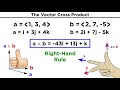
Cross Product of Vectors Concepts

Interactive Video
•
Physics
•
9th - 10th Grade
•
Practice Problem
•
Hard

Liam Anderson
FREE Resource
Read more
10 questions
Show all answers
1.
MULTIPLE CHOICE QUESTION
30 sec • 1 pt
What is the result of a dot product between two vectors?
A tensor
A matrix
A scalar
A vector
2.
MULTIPLE CHOICE QUESTION
30 sec • 1 pt
Which method is used to find the cross product of two vectors?
Matrix inversion
Matrix subtraction
Determinant of a matrix
Matrix addition
3.
MULTIPLE CHOICE QUESTION
30 sec • 1 pt
What is the direction of the cross product of two vectors?
Perpendicular to the original vectors
In the same direction as vector A
In the same direction as vector B
Parallel to the original vectors
4.
MULTIPLE CHOICE QUESTION
30 sec • 1 pt
How can you determine the direction of a cross product using your hand?
Right-hand rule
Left-hand rule
Index finger rule
Thumb rule
5.
MULTIPLE CHOICE QUESTION
30 sec • 1 pt
What is the cross product of a vector with itself?
A vector with half the magnitude
A zero vector
A unit vector
A vector with double the magnitude
6.
MULTIPLE CHOICE QUESTION
30 sec • 1 pt
What is the magnitude of the cross product of two vectors related to?
The volume of the parallelogram they form
The sum of the vectors
The area of the parallelogram they form
The difference of the vectors
7.
MULTIPLE CHOICE QUESTION
30 sec • 1 pt
What happens to the cross product of two parallel vectors?
It becomes a zero vector
It becomes a scalar
It becomes a matrix
It becomes a unit vector
Access all questions and much more by creating a free account
Create resources
Host any resource
Get auto-graded reports

Continue with Google

Continue with Email

Continue with Classlink

Continue with Clever
or continue with

Microsoft
%20(1).png)
Apple

Others
Already have an account?

