
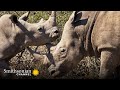
Rhino Behavior and Communication Insights

Interactive Video
•
Biology
•
6th - 7th Grade
•
Practice Problem
•
Hard

Jackson Turner
FREE Resource
Read more
10 questions
Show all answers
1.
MULTIPLE CHOICE QUESTION
30 sec • 1 pt
Why do rhinos rely on dung messages for communication?
They have excellent eyesight.
They are unable to make sounds.
They have poor eyesight.
They prefer to communicate at night.
2.
MULTIPLE CHOICE QUESTION
30 sec • 1 pt
What determines the size of a male white rhino's territory?
The dominance of the male.
The number of females in the area.
The age of the male.
The amount of food available.
3.
MULTIPLE CHOICE QUESTION
30 sec • 1 pt
What is the purpose of communal dung heaps in rhino territories?
To mark the boundaries of their territory.
To provide a place for rhinos to rest.
To serve as message boards for communication.
To attract other animals.
4.
MULTIPLE CHOICE QUESTION
30 sec • 1 pt
What kind of information can be found in rhino dung?
The rhino's gender and health.
The rhino's color.
The rhino's age.
The rhino's favorite food.
5.
MULTIPLE CHOICE QUESTION
30 sec • 1 pt
How do rhinos use the chemical traces in dung?
To locate food.
To find water sources.
To identify predators.
To understand social hierarchies.
6.
MULTIPLE CHOICE QUESTION
30 sec • 1 pt
What is the significance of large dung heaps on busy routes?
They indicate a lack of predators.
They are a sign of a healthy ecosystem.
They serve as major information centers.
They are used for nesting.
7.
MULTIPLE CHOICE QUESTION
30 sec • 1 pt
How do young rhinos learn about social hierarchies?
By observing fights between older rhinos.
By listening to the calls of other rhinos.
Through the scents in dung.
By following their mothers.
Access all questions and much more by creating a free account
Create resources
Host any resource
Get auto-graded reports

Continue with Google

Continue with Email

Continue with Classlink

Continue with Clever
or continue with

Microsoft
%20(1).png)
Apple

Others
Already have an account?
Similar Resources on Wayground

6 questions
Alligator Bellowing Behavior and Purpose
Interactive video
•
5th - 8th Grade
6 questions
Tree Frog Behavior and Adaptations
Interactive video
•
5th - 8th Grade
11 questions
Remote Sensing Techniques for Ocean Monitoring and Marine Life Tracking
Interactive video
•
6th - 8th Grade
11 questions
Exploring Amboseli National Park and Maasai Culture
Interactive video
•
5th - 8th Grade
11 questions
American Green Tree Frog Facts
Interactive video
•
5th - 8th Grade
11 questions
Wildlife Behavior and Ecosystem Roles
Interactive video
•
5th - 6th Grade
11 questions
Christmas Card Design Process
Interactive video
•
6th - 7th Grade
6 questions
Andean Bear Identification and Characteristics
Interactive video
•
5th - 6th Grade
Popular Resources on Wayground
15 questions
Fractions on a Number Line

Quiz
•
3rd Grade
20 questions
Equivalent Fractions
Quiz
•
3rd Grade
25 questions
Multiplication Facts
Quiz
•
5th Grade
29 questions
Alg. 1 Section 5.1 Coordinate Plane
Quiz
•
9th Grade
22 questions
fractions
Quiz
•
3rd Grade
11 questions
FOREST Effective communication

Lesson
•
KG
20 questions
Main Idea and Details
Quiz
•
5th Grade
20 questions
Context Clues
Quiz
•
6th Grade
Discover more resources for Biology
20 questions
Food Chains and Food Webs
Quiz
•
7th - 12th Grade
10 questions
Exploring Food Webs and Energy Pyramids
Interactive video
•
6th - 10th Grade
10 questions
Exploring the Impact of Genetic Mutations
Interactive video
•
6th - 10th Grade
20 questions
Cell Division
Quiz
•
7th Grade
5 questions
Inherited and Acquired Traits of Animals
Interactive video
•
4th Grade - University
20 questions
Adaptations and Natural Selection
Quiz
•
7th Grade
20 questions
Symbiotic Relationships - Ecology
Quiz
•
6th - 8th Grade
10 questions
Comparing Mitosis and Meiosis: Key Differences and Stages
Interactive video
•
6th - 10th Grade