
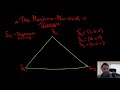
Decision-Making and Preference Theories

Interactive Video
•
Mathematics
•
11th - 12th Grade
•
Hard

Thomas White
FREE Resource
Read more
9 questions
Show all answers
1.
MULTIPLE CHOICE QUESTION
30 sec • 1 pt
What is the primary purpose of the Maschine Mercek Triangle?
To predict stock market trends
To design lottery games
To calculate probabilities
To model preferences over lotteries
2.
MULTIPLE CHOICE QUESTION
30 sec • 1 pt
What is another term for a degenerate lottery?
Uncertain lottery
Simple lottery
Complex lottery
Random lottery
3.
MULTIPLE CHOICE QUESTION
30 sec • 1 pt
In the context of the simplex method, what does a point with one-third probability represent?
A certain outcome
An equal distribution among outcomes
A preference for one outcome
A random selection
4.
MULTIPLE CHOICE QUESTION
30 sec • 1 pt
What theorem is used to visualize the requirements for preferences to have an expected utility function?
Central Limit Theorem
Von Neumann-Morgenstern Theorem
Game Theory Theorem
Bayes' Theorem
5.
MULTIPLE CHOICE QUESTION
30 sec • 1 pt
Which of the following is NOT a requirement for rational preferences?
Randomness
Transitivity
Completeness
Independence
6.
MULTIPLE CHOICE QUESTION
30 sec • 1 pt
What does mixture continuity imply in decision-making?
Preferences are always uncertain
Preferences are based on past experiences
Preferences remain unchanged when mixed with other factors
Preferences change with new information
7.
MULTIPLE CHOICE QUESTION
30 sec • 1 pt
In a well-behaved case, what do indifference curves represent?
Levels of dissatisfaction
Levels of utility
Levels of risk
Levels of probability
Access all questions and much more by creating a free account
Create resources
Host any resource
Get auto-graded reports

Continue with Google

Continue with Email

Continue with Classlink

Continue with Clever
or continue with

Microsoft
%20(1).png)
Apple

Others
Already have an account?
Similar Resources on Wayground

11 questions
Understanding the Universe: From Particles to String Theory
Interactive video
•
10th - 12th Grade
11 questions
Understanding Sequence Convergence and Divergence
Interactive video
•
10th - 12th Grade
6 questions
What is the distance formula and how do you derive it
Interactive video
•
11th Grade - University
6 questions
How to determine the sum of a finite geometric sequence
Interactive video
•
11th Grade - University
8 questions
Introduction to Basic Proportionality Theorem
Interactive video
•
10th Grade - University
11 questions
Complex Powers and De Moivre's Theorem
Interactive video
•
11th - 12th Grade
11 questions
Understanding Functions and Integration Concepts
Interactive video
•
11th - 12th Grade
11 questions
Complex Numbers and Their Properties
Interactive video
•
11th - 12th Grade
Popular Resources on Wayground
15 questions
Fractions on a Number Line

Quiz
•
3rd Grade
10 questions
Probability Practice
Quiz
•
4th Grade
15 questions
Probability on Number LIne
Quiz
•
4th Grade
20 questions
Equivalent Fractions
Quiz
•
3rd Grade
25 questions
Multiplication Facts
Quiz
•
5th Grade
22 questions
fractions
Quiz
•
3rd Grade
6 questions
Appropriate Chromebook Usage

Lesson
•
7th Grade
10 questions
Greek Bases tele and phon
Quiz
•
6th - 8th Grade
Discover more resources for Mathematics
23 questions
TSI Math Vocabulary
Quiz
•
10th - 12th Grade
80 questions
ACT Math Important Vocabulary
Quiz
•
11th Grade
20 questions
SSS/SAS
Quiz
•
9th - 12th Grade
15 questions
Exponential Growth and Decay Word Problems Practice
Quiz
•
9th - 12th Grade
20 questions
9.1 & 9.2 Exponential Growth and Decay
Quiz
•
12th Grade
11 questions
Slopes of Parallel and Perpendicular Lines
Quiz
•
7th - 11th Grade
13 questions
Identify Transformations in Geometry
Quiz
•
8th - 12th Grade
20 questions
Quadratic Transformations Review
Quiz
•
9th - 12th Grade