
P1B 02 Oceanic Conveyor Belt and Thermohaline Circulation
Authored by Wayground Content
Geography
11th Grade
Used 2+ times


AI Actions
Add similar questions
Adjust reading levels
Convert to real-world scenario
Translate activity
More...
Content View
Student View
14 questions
Show all answers
1.
MULTIPLE CHOICE QUESTION
30 sec • 1 pt
Winds blowing warm, moisture-filled air to Europe
Decrease the temperature and precipitation of Western Europe.
Have no effect on the climate of Western Europe.
Increase the temperature and precipitation of Western Europe.
Cause severe droughts in Western Europe.
2.
MULTIPLE CHOICE QUESTION
30 sec • 1 pt
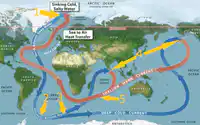
Stage 1 of the Oceanic Conveyor
Cold, salty, dense water sinks at the Earth's northern polar region and heads south along the western Atlantic basin.
Warm, fresh water rises at the equator and flows towards the poles.
Cold, fresh water flows from the southern polar region to the equator.
Warm, salty water sinks in the Indian Ocean and circulates around the globe.
3.
MULTIPLE CHOICE QUESTION
30 sec • 1 pt
Use of carbon dioxide by algae
Carbon dioxide is used by algae for photosynthesis.
Algae release carbon dioxide during respiration.
Carbon dioxide is toxic to algae and inhibits growth.
Algae absorb carbon dioxide only at night.
4.
MULTIPLE CHOICE QUESTION
30 sec • 1 pt
Movement of oxygen by the conveyor
The conveyor moves oxygen from the top of the ocean, where it is produced by algae, to deeper layers.
The conveyor transports oxygen from the ocean floor to the surface for photosynthesis.
The conveyor circulates oxygen throughout the atmosphere to support terrestrial life.
The conveyor filters oxygen from the water to release it into the air.
5.
MULTIPLE CHOICE QUESTION
30 sec • 1 pt
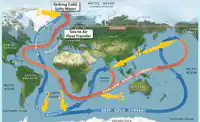
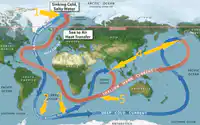
Map showing global ocean currents
Ocean currents have no impact on climate.
Ocean currents help in distributing heat around the planet.
Ocean currents only affect marine life.
Ocean currents are only found in the Arctic region.
6.
MULTIPLE CHOICE QUESTION
30 sec • 1 pt
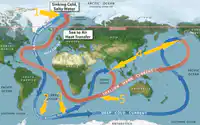
Oceanic Conveyor Belt or Thermohaline Circulation (THC)
A global-scale circulation of ocean water, consisting of both surface and deep-sea currents.
A phenomenon that only affects surface water temperatures.
A type of current that only occurs in the Atlantic Ocean.
A process that is unrelated to climate change.
7.
MULTIPLE CHOICE QUESTION
30 sec • 1 pt
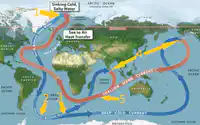
Warming of the Current in Stage 4
The current cools and sinks as it travels southward, affecting global water temperatures.
The current warms and rises as it travels northward, influencing global water temperatures.
The current remains stable and does not affect global water temperatures.
The current warms and flows eastward, decreasing global water temperatures.
Access all questions and much more by creating a free account
Create resources
Host any resource
Get auto-graded reports

Continue with Google

Continue with Email

Continue with Classlink

Continue with Clever
or continue with

Microsoft
%20(1).png)
Apple

Others
Already have an account?

