
VLAN & Trunking Quiz
Authored by Mrtada .
Computers
Professional Development


AI Actions
Add similar questions
Adjust reading levels
Convert to real-world scenario
Translate activity
More...
Content View
Student View
10 questions
Show all answers
1.
MULTIPLE CHOICE QUESTION
30 sec • 1 pt
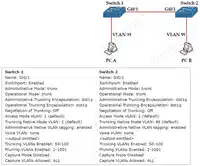
Refer to the exhibit. After the switch configuration the ping test fails between PC A and PC B. Based on the output for switch 1, which error must be corrected?
There is a native VLAN mismatch
Access mode is configured on the switch ports.
The PCs are in the incorrect VLAN
All VLANs are not enabled on the trunk
Answer explanation
From the output we see the native VLAN of Switch1 on Gi0/1 interface is VLAN 1 while that of Switch2 is VLAN 99 so there would be a native VLAN mismatch.
2.
MULTIPLE CHOICE QUESTION
30 sec • 1 pt
Two switches are connected and using Cisco Dynamic Trunking Protocol. SW1 is set to Dynamic Desirable. What is the result of this configuration?
The link is in a downstate.
The link is in an error disables stale
The link is becomes an access port
The link becomes a trunkport
3.
MULTIPLE CHOICE QUESTION
30 sec • 1 pt

Refer to exhibit. Which action do the switches take on the trunk link?
The trunk does not form and the ports go into an err-disabled status
The trunk forms but the mismatched native VLANs are merged into a single broadcast domain
The trunk does not form, but VLAN 99 and VLAN 999 are allowed to traverse the link
The trunk forms but VLAN 99 and VLAN 999 are in a shutdown state
Answer explanation
The trunk still forms with mismatched native VLANs and the traffic can actually flow between mismatched switches. But it is absolutely necessary that the native VLANs on both ends of a trunk link match; otherwise a native VLAN mismatch occurs, causing the two VLANs to effectively merge. For example with the above configuration, SW1 would send untagged frames for VLAN 999. SW2 receives them but would think they are for VLAN 99 so we can say these two VLANs are merged.
4.
MULTIPLE CHOICE QUESTION
30 sec • 1 pt

Refer to the exhibit. The network administrator wants VLAN 67 traffic to be untagged between Switch 1 and Switch 2 while all other VLANs are to remain tagged. Which command accomplishes this task?
switchport access vlan 67
switchport trunk allowed vlan 67
switchport private-vlan association host 67
switchport trunk native vlan 67
5.
MULTIPLE CHOICE QUESTION
30 sec • 1 pt
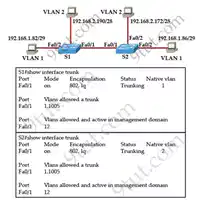
Refer to the exhibit. A frame from VLAN1 of switch S1 is sent to switch S2 where the frame received on VLAN2. What causes this behavior?
trunk mode mismatches
VLANs that do not correspond to a unique IP subnet
native vlan mismatches
allowing only vlan 2 on the destination
Answer explanation
For 802.1q encapsulation, the native VLAN must matched at both side; otherwise the link will not work. In this case the native VLAN of S1 is 1 while the native VLAN of S2 is 2. Therefore when a frame from VLAN 1 is sent from S1 to S2, it will be untagged before leaving S1. When S2 receives this untagged frame, it believes this frame was sent from the native VLAN. But the native VLAN on S2 is VLAN 2, not VLAN 1. Therefore only hosts on VLAN2 of S2 will receive this frame.
6.
MULTIPLE CHOICE QUESTION
30 sec • 1 pt
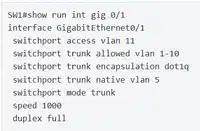
Refer to the exhibit. Which action is expected from SW1 when the untagged frame is received on the GigabitEthernet0/1 interface?
The frame is processed in VLAN 5
The frame is processed in VLAN 11
The frame is processed in VLAN 1
The frame is dropped
7.
MULTIPLE CHOICE QUESTION
30 sec • 1 pt

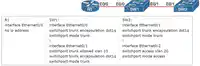
Refer to the exhibit. A network administrator is configuring an EtherChannel between SW1 and SW2. The SW1 configuration is shown. What is the correct configuration for SW2?
interface FastEthernet 0/1 channel-group 1 mode active switchport trunk encapsulation dot1q switchport mode trunk ! interface FastEthernet 0/2 channel-group 1 mode active switchport trunk encapsulation dot1q switchport mode trunk
interface FastEthernet 0/1 channel-group 2 mode auto switchport trunk encapsulation dot1q switchport mode trunk ! interface FastEthernet 0/2 channel-group 2 mode auto switchport trunk encapsulation dot1q switchport mode trunk
interface FastEthernet 0/1 channel-group 1 mode desirable switchport trunk encapsulation dot1q switchport mode trunk ! interface FastEthernet 0/2 channel-group 1 mode desirable switchport trunk encapsulation dot1q switchport mode trunk
interface FastEthernet 0/1 channel-group 1 mode passive switchport trunk encapsulation dot1q switchport mode trunk ! interface FastEthernet 0/2 channel-group 1 mode passive switchport trunk encapsulation dot1q switchport mode trunk
Answer explanation
From the configuration of SW1, we see it is using Port Aggregation Protocol (PAgP) with “auto” mode so the other end (SW2) must also runs PAgP with “desirable” mode to actively sending request to form an Etherchannel.

Access all questions and much more by creating a free account
Create resources
Host any resource
Get auto-graded reports

Continue with Google

Continue with Email

Continue with Classlink

Continue with Clever
or continue with

Microsoft
%20(1).png)
Apple

Others
Already have an account?

