
Skillful 4 R&W - Unit 1 Synonyms, Register and AC Vocab
Authored by Leonid Kanev
English
9th - 12th Grade
Register covered
Used 4+ times


AI Actions
Add similar questions
Adjust reading levels
Convert to real-world scenario
Translate activity
More...
Content View
Student View
13 questions
Show all answers
1.
LABELLING QUESTION
1 min • 8 pts
This text has a lot of repetition and small issues with formality. Use the correct formal synonyms.
Tags
Synonyms
2.
DRAG AND DROP QUESTION
45 sec • 4 pts
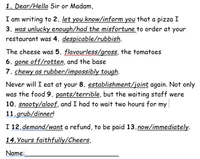
Requirement: Formal, assertive, but polite.
1. (a) Dear/Hello Sir or Madam,
I am writing to 2 (b) let you know/inform you that a pizza I 3 (c) . was unlucky enough/had the misfortune to order at your restaurant was 4. (d) despicable/rubbish.
Answer explanation
Dear vs Hello –
"Dear" is the standard, formal way to begin a letter, especially a complaint, to someone you don’t know personally. "Hello" is informal and better suited for casual or friendly emails.
Inform you vs let you know –
"Inform you" is formal and precise, often used in business or official communication. "Let you know" is conversational and informal.
Had the misfortune vs was unlucky enough –
"Had the misfortune" is more formal and emotionally neutral, while "was unlucky enough" sounds casual and conversational.
Rubbish vs despicable –
Here "rubbish" works as formal-enough British English for "very poor quality" without sounding overly emotional. "Despicable" is very strong and implies moral outrage, which may seem overly aggressive in a complaint letter.
Dear vs Hello –
"Dear" is the standard, formal way to begin a letter, especially a complaint, to someone you don’t know personally. "Hello" is informal and better suited for casual or friendly emails.
Inform you vs let you know –
"Inform you" is formal and precise, often used in business or official communication. "Let you know" is conversational and informal.
Had the misfortune vs was unlucky enough –
"Had the misfortune" is more formal and emotionally neutral, while "was unlucky enough" sounds casual and conversational.
Rubbish vs despicable –
Here "rubbish" works as formal-enough British English for "very poor quality" without sounding overly emotional. "Despicable" is very strong and implies moral outrage, which may seem overly aggressive in a complaint letter.
Tags
Register
3.
DRAG AND DROP QUESTION
45 sec • 4 pts
Requirement: Formal, assertive, but polite.
1. (a) Dear/Hello Sir or Madam,
I am writing to 2 (b) let you know/inform you that a pizza I 3 (c) . was unlucky enough/had the misfortune to order at your restaurant was 4. (d) despicable/rubbish.
Answer explanation
Dear vs Hello –
"Dear" is the standard, formal way to begin a letter, especially a complaint, to someone you don’t know personally. "Hello" is informal and better suited for casual or friendly emails.
Inform you vs let you know –
"Inform you" is formal and precise, often used in business or official communication. "Let you know" is conversational and informal.
Had the misfortune vs was unlucky enough –
"Had the misfortune" is more formal and emotionally neutral, while "was unlucky enough" sounds casual and conversational.
Rubbish vs despicable –
Here "rubbish" works as formal-enough British English for "very poor quality" without sounding overly emotional. "Despicable" is very strong and implies moral outrage, which may seem overly aggressive in a complaint letter.
Dear vs Hello –
"Dear" is the standard, formal way to begin a letter, especially a complaint, to someone you don’t know personally. "Hello" is informal and better suited for casual or friendly emails.
Inform you vs let you know –
"Inform you" is formal and precise, often used in business or official communication. "Let you know" is conversational and informal.
Had the misfortune vs was unlucky enough –
"Had the misfortune" is more formal and emotionally neutral, while "was unlucky enough" sounds casual and conversational.
Rubbish vs despicable –
Here "rubbish" works as formal-enough British English for "very poor quality" without sounding overly emotional. "Despicable" is very strong and implies moral outrage, which may seem overly aggressive in a complaint letter.
Tags
Register
4.
FILL IN THE BLANKS QUESTION
20 sec • 1 pt
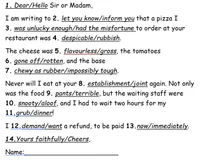
Requirement: Formal, assertive, but polite.
5.
(a)
Answer explanation
"Flavourless" is descriptive and polite, focusing on the quality of the food. "Gross" is slangy and emotionally charged.
Tags
Register
5.
FILL IN THE BLANKS QUESTION
20 sec • 1 pt
Requirement: Formal, assertive, but polite.
6.
(a)
Answer explanation
Rotten vs gone off –
"Rotten" is the standard, more formal term for spoiled food. "Gone off" is informal British slang.
Tags
Register
6.
DROPDOWN QUESTION
20 sec • 1 pt
Requirement: Formal, assertive, but polite.
7. (a)
Answer explanation
Impossibly tough vs chewy as rubber –
"Impossibly tough" is formal and straightforward. "Chewy as rubber" is colorful but informal and metaphorical.
Tags
Register
7.
DROPDOWN QUESTION
20 sec • 1 pt
Requirement: Formal, assertive, but polite.
8. (a)
Answer explanation
Establishment vs joint –
"Establishment" is a formal, respectful term for a business. "Joint" is slang for a place, often used casually and sometimes derogatorily.
Tags
Register
Access all questions and much more by creating a free account
Create resources
Host any resource
Get auto-graded reports

Continue with Google

Continue with Email

Continue with Classlink

Continue with Clever
or continue with

Microsoft
%20(1).png)
Apple

Others
Already have an account?



