
Representing Sample Spaces for Compound Events Using Organized Lists, Tables, and Tree Diagrams
Authored by Kartik Garg
Mathematics
7th Grade
CCSS covered


AI Actions
Add similar questions
Adjust reading levels
Convert to real-world scenario
Translate activity
More...
Content View
Student View
15 questions
Show all answers
1.
MULTIPLE CHOICE QUESTION
1 min • 1 pt
Lori passes 80% of her tests. In the next week, Lori has 4 tests. She wants to determine the probability that she passes all 4 of the tests. Which simulation design has an appropriate device and a correct trial?
Roll a die letting 1-5 represent Lori passing a test and 6 represent Lori failing a test. Roll the die four
times.
Let Heads represent Lori passing a test and Tails represent Lori failing a test. Flip the coin four times.
Using a random digits table select one digit numbers where 0-8 is a passing grade and 9 is a failing
grade. Select four digits.
Spin a spinner that is split up into 5 sections, where 4 sections are a success of passing a test. Spin
the spinner four times.
2.
MULTIPLE CHOICE QUESTION
1 min • 1 pt
Jack tossed a coin three times. Which tree diagram shows all the possible outcomes of the coin landing heads up or tails up?


3.
MULTIPLE CHOICE QUESTION
1 min • 1 pt
A key ring has 12 keys, 3 of which open the house door. If two keys are randomly selected without replacement, what is the probability that neither key opens the door?
4.
MULTIPLE CHOICE QUESTION
1 min • 1 pt

Which of the following shows how to determine P(diamond or face card)? Ν
13/52 + 12/52 - 3/52
3/52 + 13/52 -12/52
3/52 + 12/52 - 13/52
1/13 + 3/52 - 1/4
Answer explanation
Non Mutually Exclusive Probability
Tags
CCSS.7.SP.C.5
CCSS.7.SP.C.7
CCSS.7.SP.C.8
5.
MULTIPLE CHOICE QUESTION
1 min • 1 pt

Which of the following shows how to determine P(king or a red card)?
4/52 + 2/52 - 26/52
1/13 + 1/26 - 1/2
4/52 + 26/52 - 2/52
2/52 + 4/52 - 26/52
6.
MULTIPLE CHOICE QUESTION
1 min • 1 pt

Use the table of probabilities to find P(D).
0.4
0.3
0.2
0.1
7.
MULTIPLE CHOICE QUESTION
1 min • 5 pts
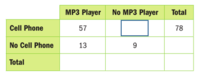
What number should go in the blue box?
21
135
19
22
Tags
CCSS.7.EE.B.3
CCSS.7.NS.A.1
CCSS.7.NS.A.2
CCSS.7.NS.A.3


Access all questions and much more by creating a free account
Create resources
Host any resource
Get auto-graded reports

Continue with Google

Continue with Email

Continue with Classlink

Continue with Clever
or continue with

Microsoft
%20(1).png)
Apple

Others
Already have an account?


