
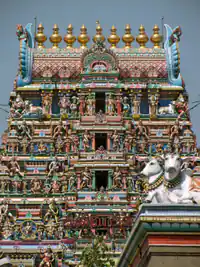
What did Ancient Indian cities ACTUALLY look like?

Interactive Video
•
Social Studies
•
9th Grade
•
Practice Problem
•
Hard

Wendy Moyers
FREE Resource
13 questions
Show all answers
1.
MULTIPLE CHOICE QUESTION
30 sec • 1 pt
What were the primary reasons for the scarcity of ancient Indian city ruins, excluding invasions?
Frequent natural disasters like floods and earthquakes.
The widespread use of perishable building materials and the repurposing of stone.
Lack of interest in preserving historical structures by subsequent rulers.
Extensive urbanization that completely built over older sites.
2.
MULTIPLE CHOICE QUESTION
30 sec • 1 pt
Which statement best describes the hygiene and sanitation systems in ancient Indian cities?
They primarily relied on open sewers and public defecation.
They were rudimentary, with waste disposed of in nearby rivers without treatment.
They featured sophisticated toilets connected to city-wide drainage systems made of brick and stone.
Only the elite had access to private, advanced sanitation facilities.
3.
MULTIPLE CHOICE QUESTION
30 sec • 1 pt
How did ancient Indian cities manage their solid waste and garbage?
Waste was left to accumulate in public areas, leading to poor hygiene.
It was collected in designated bins within the city and then transported to the outskirts for composting, burning, or burial.
All garbage was thrown into the main river, relying on the current to carry it away.
Citizens were solely responsible for disposing of their own waste, with no centralized system.
4.
MULTIPLE CHOICE QUESTION
30 sec • 1 pt
Beyond natural sources, how did ancient Indian cities ensure a consistent water supply, especially during dry periods?
They imported water from distant mountain ranges using complex aqueducts.
They relied heavily on individual household wells, which were often insufficient.
They constructed large tanks, reservoirs, and elaborate stepwells to collect and store rainwater.
Water was rationed strictly, and bathing was prohibited during dry seasons.
5.
MULTIPLE CHOICE QUESTION
30 sec • 1 pt
What characteristics did Megasthenes observe about the city of Pataliputra's neighborhoods?
They were randomly arranged with narrow, winding streets.
They were well-planned with orderly rows of houses, broad streets, and distinct social quarters.
They primarily consisted of temporary structures and lacked public spaces.
They were designed without consideration for different social groups.
6.
MULTIPLE CHOICE QUESTION
30 sec • 1 pt
How did the architectural design of ancient Indian houses differ between drier inland regions and lush coastal regions?
Inland houses used wood and bamboo with sloping roofs, while coastal houses used stone and brick with flat roofs.
Inland houses were built with stone or brick and had flat roofs, whereas coastal houses used wood, bamboo, and terracotta with sloping roofs.
Both regions primarily used mud and thatch, but coastal houses had larger courtyards.
Inland houses were multi-story, while coastal houses were single-story.
7.
MULTIPLE CHOICE QUESTION
30 sec • 1 pt
What was a key feature of the common courtyard house design in ancient India?
All rooms were directly accessible from the street for easy public interaction.
A central courtyard provided light, ventilation, and space for domestic activities.
Houses were built without windows to maximize privacy.
They were exclusively single-room dwellings with no private areas.
Access all questions and much more by creating a free account
Create resources
Host any resource
Get auto-graded reports

Continue with Google

Continue with Email

Continue with Classlink

Continue with Clever
or continue with

Microsoft
%20(1).png)
Apple

Others
Already have an account?

