
Properties of Waves (Part 1)
Authored by Amanda Greeves
Science
6th - 8th Grade
NGSS covered


AI Actions
Add similar questions
Adjust reading levels
Convert to real-world scenario
Translate activity
More...
Content View
Student View
25 questions
Show all answers
1.
MULTIPLE CHOICE QUESTION
30 sec • 1 pt
What does Raelene observe about the ocean waves during a windy day at the beach?
The waves grow taller and crash harder on the shore.
The waves become calm and barely break.
The waves disappear completely.
The waves move in a straight line.
2.
MULTIPLE CHOICE QUESTION
30 sec • 1 pt
Predict which wave has the highest amount of energy traveling through it.


Answer explanation
In a transverse wave, a higher crest corresponds to a higher amount of energy in the wave. This is called amplitude, which will be discussed later in this lesson.
Tags
NGSS.MS-PS4-1
3.
MULTIPLE CHOICE QUESTION
30 sec • 1 pt
Predict which wave is the longest.


Answer explanation

In a transverse wave, the length between two consecutive troughs or crests equals its wavelength, which will be discussed later in the lesson. A longer distance between two crests or two troughs equals a longer wavelength.
Tags
NGSS.MS-PS4-1
4.
DROPDOWN QUESTION
1 min • 1 pt
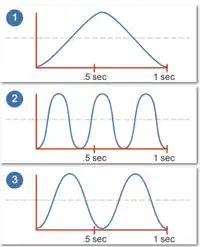
Make a prediction to complete the following sentence:
The waves in diagram (a) are occurring most frequently because the wave repeats (b) times in one second. This measurement is called (c) , which will be discussed later in the lesson.
Tags
NGSS.MS-PS4-1
5.
MULTIPLE CHOICE QUESTION
30 sec • 1 pt
Predict which wave is traveling the fastest.


Tags
NGSS.MS-PS4-1
6.
DRAG AND DROP QUESTION
1 min • 1 pt
The (a) of a wave depends on both its (b) and its (c) , which help determine how far it can travel in a certain amount of time. These two waves have the same frequency, but the wave with the longer wavelength travels farther. Therefore, its (d) is higher. Speed will be discussed further later in the lesson.
7.
MULTIPLE CHOICE QUESTION
30 sec • 1 pt
Which of these waves has the lowest amplitude?


Tags
NGSS.MS-PS4-1


Access all questions and much more by creating a free account
Create resources
Host any resource
Get auto-graded reports

Continue with Google

Continue with Email

Continue with Microsoft
or continue with

%20(1).png)
Apple

Others
By signing up, you agree to our Terms of Service & Privacy Policy
Already have an account?



