
Nervous System Test
Authored by Tricia Hudson
Science
11th Grade
NGSS covered
Used 6+ times


AI Actions
Add similar questions
Adjust reading levels
Convert to real-world scenario
Translate activity
More...
Content View
Student View
30 questions
Show all answers
1.
MULTIPLE CHOICE QUESTION
2 mins • 1 pt
Which of the following best describes how myelination affects the transmission of nerve impulse?
It speeds up the transmission of impulses by acting as an electrical insulator.
It speeds up the transmission of impulses by integrating signal information more quickly.
It slows down the transmission of impulses by forming gaps called the nodes of Ranvier.
It slows down the transmission of impulses by blocking the movement of ions across the membrane.
2.
MULTIPLE CHOICE QUESTION
2 mins • 1 pt
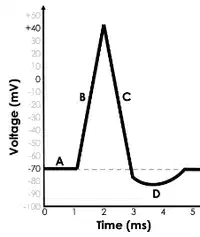
To increase the strength of a nerve signal, neurons will
increase the frequency of the action potential.
increase the voltage of the action potential.
decrease the frequency of the action potential.
decrease the voltage of the action potential.
3.
MULTIPLE CHOICE QUESTION
2 mins • 1 pt
Which organelle is responsible for releasing neurotransmitters into the synaptic cleft?
Vacuoles
Vesicles
Channel proteins
Ca2+
4.
MULTIPLE CHOICE QUESTION
2 mins • 1 pt
The most specific division of the nervous system responsible for our “fight or flight” response is the
sensory division.
parasympathetic.
autonomic.
sympathetic.
5.
MULTIPLE CHOICE QUESTION
2 mins • 1 pt
Which type of neuron is responsible for transmitting information from the central nervous system to the rest of the body?
Sensory neurons
Afferent neurons
Motor neurons
Interneurons
6.
MULTIPLE CHOICE QUESTION
2 mins • 1 pt
Which of the following statements does not apply to the parasympathetic division?
It is a division of the autonomic nervous system.
It communicates to more than one effector organ at a time.
It is antagonistic to the sympathetic division.
It maintains the body’s regulatory processes, such as digestion and excretion.
Tags
NGSS.HS-LS1-3
7.
MULTIPLE CHOICE QUESTION
2 mins • 1 pt
The sensory nerve receptors in the ear that respond to vibrations are classified as
chemoreceptors.
nociceptors.
thermoreceptors.
mechanoreceptors.
Tags
NGSS.MS-LS1-8

Access all questions and much more by creating a free account
Create resources
Host any resource
Get auto-graded reports

Continue with Google

Continue with Email

Continue with Microsoft
or continue with

%20(1).png)
Apple

Others
By signing up, you agree to our Terms of Service & Privacy Policy
Already have an account?


