
June 2025 US History Regents Review
Authored by Donald Wallace
Social Studies
11th Grade
Used 2+ times


AI Actions
Add similar questions
Adjust reading levels
Convert to real-world scenario
Translate activity
More...
Content View
Student View
28 questions
Show all answers
1.
MULTIPLE CHOICE QUESTION
30 sec • 1 pt

Engraving: The Town of Secota, 1590. Shows an organized Native American village with crops and housing. Question: Which statement about Native American societies can be inferred from this engraving?
Answer explanation
Context: Native village before Europeans take over.
Gist of image: Neat fields, roads, houses, people working.
1️⃣ The inhabitants valued entertainment over field work. ❌ You can see lots of farming, not parties.
2️⃣ Layouts of their villages were based on European societies. ❌ This is a Native town, 1590, before English towns here.
3️⃣ Internal conflict and disease led to their decline. ❌ Nothing in the picture shows fighting or sickness.
4️⃣ Their communities were planned and supported an organized way of life. ✅ Fields and homes in rows, clear paths, looks organized.
2.
MULTIPLE CHOICE QUESTION
30 sec • 1 pt
Engraving: The Town of Secota, 1590. Question: A historian would find this engraving most useful for
Answer explanation
Context: Historians use pictures to learn about the past.
Gist: Title says Native town, 1590.
1️⃣ describing Native American societies prior to European colonization ✅ Shows what Native life looked like before large European settlements.
2️⃣ examining the way Native Americans dealt with hardship ❌ We do not see drought, war, or disaster.
3️⃣ illustrating the influence colonial leaders had on Native American societies ❌ No colonists or leaders here.
4️⃣ understanding the trading patterns of Native American societies ❌ No clear trade routes or goods shown.
3.
MULTIPLE CHOICE QUESTION
30 sec • 1 pt
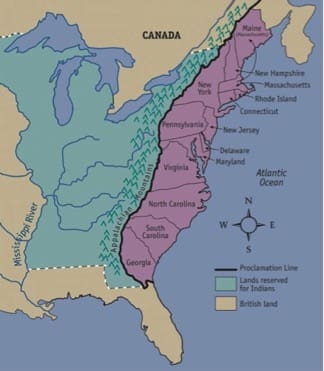
Map: North America, 1775. Shows the Proclamation Line of 1763 running along the western border of the colonies. Question: The Proclamation Line of 1763 generally followed which geographic feature?
Answer explanation
Context: Britain tries to stop westward movement after French and Indian War.
Gist: Line hugs the first mountain chain west of the colonies.
1️⃣ Great Lakes ❌ Those are big blobs of water, not a long skinny line.
2️⃣ Appalachian Mountains ✅ Eastern mountain chain that matches the line.
3️⃣ Rocky Mountains ❌ Way farther west than the colonies.
4️⃣ Mississippi River ❌ Straight-ish river, not jagged like mountains.
4.
MULTIPLE CHOICE QUESTION
30 sec • 1 pt
Map: North America, 1775. Question: How did many American colonists respond to the establishment of the Proclamation Line of 1763?
Answer explanation
Context: Colonists want land, Britain says “stop.”
Gist: Line blocks settlers from moving west.
1️⃣ They argued it was an abuse of British authority. ✅ Fits the usual colonist attitude: “you are too controlling.”
2️⃣ They established a colony on the Florida peninsula. ❌ Not about the line at all.
3️⃣ They honored Native American treaties. ❌ That would mean they happily obeyed, which is the opposite.
4️⃣ They purchased land needed to construct the National Road. ❌ National Road is later, not about this.
5.
MULTIPLE CHOICE QUESTION
30 sec • 1 pt

Passage: Alexander Hamilton, Federalist No. 15, 1787. "The measures of the Union have not been executed... the frail and tottering edifice seems ready to fall..." Question: Based on this passage, what action would Alexander Hamilton recommend?
Answer explanation
Correct answer: 1️⃣ strengthening the national government ✅
Historical context:
Under the Articles of Confederation, the national (federal) government was weak and could not enforce laws or collect enough taxes.
Hamilton was a Federalist. Think: “Federalist = wants a strong FEDERAL government.” 💪
Gist of the passage:
He calls the current system a “frail and tottering edifice” that might fall down.
That sounds like he thinks the national government is too weak.
Using context clues to eliminate:
4️⃣ continuing to use the Articles of Confederation ❌ He is clearly complaining about that system, not keeping it.
2️⃣ establishing a monarchy ❌ He never says “king” or anything royal.
3️⃣ increasing the power of the states ❌ Federalists want federal power, not more state power.
1️⃣ strengthening the national government ✅ Matches both the complaint and the word Federalist.
6.
MULTIPLE CHOICE QUESTION
30 sec • 1 pt

Passage: Alexander Hamilton, Federalist No. 15, 1787. Question: Based on this passage, the purpose of the Federalist Papers was to
Answer explanation
Correct answer: 3️⃣ support ratification of the Constitution ✅
“Federalist” again = strong federal / national government.
After writing the new Constitution, states had to ratify it.
Ratify = officially approve / vote yes on a document. 🗳️
Federalists wrote essays (the Federalist Papers) to convince people to ratify the Constitution.
Gist of the question:
It asks: what were the Federalist Papers trying to do?
Using context clues to eliminate:
1️⃣ discourage the creation of political parties ❌ Parties are not the main topic of these essays.
2️⃣ justify the American Revolution to the colonists ❌ Revolution was already over; different time period.
4️⃣ argue for a bill of rights ❌ That was mostly the Anti-Federalists, not the Federalists.
3️⃣ support ratification of the Constitution ✅ Matches both:
the word Federalist,
and what “ratify” means: get the Constitution officially passed.
7.
MULTIPLE CHOICE QUESTION
30 sec • 1 pt

Excerpt: Marbury v. Madison, 1803. "It is emphatically the province and duty of the judicial department to say what the law is." Question: The Supreme Court's decision in this case established the principle of
Answer explanation
Correct answer: 3️⃣ judicial review ✅
Historical context:
Early 1800s, the new federal government is figuring out how powerful the Supreme Court will be.
Marbury v. Madison (1803) is the big case where the Court says it can rule laws unconstitutional.
Gist of the excerpt:
Marshall says the Constitution is the “fundamental and paramount law.”
If a law goes against the Constitution, it is “void.”
He says it is the “province and duty of the judicial department to say what the law is.”
Using clues to eliminate:
1️⃣ states’ rights ❌ That is about states vs. federal government. The excerpt talks about courts and laws, not states.
2️⃣ nullification ❌ That is when states cancel federal laws. Again, this is about courts, not states.
3️⃣ judicial review ✅ “Judicial” = courts, “review” = check laws. The quote literally describes courts deciding if laws are constitutional.
4️⃣ popular sovereignty ❌ That is about the people voting, not judges.


Access all questions and much more by creating a free account
Create resources
Host any resource
Get auto-graded reports

Continue with Google

Continue with Email

Continue with Classlink

Continue with Clever
or continue with

Microsoft
%20(1).png)
Apple

Others
Already have an account?

