
OMFS QUIZ 3
Authored by Nighat Zahid
Health Sciences
University
Used 1+ times


AI Actions
Add similar questions
Adjust reading levels
Convert to real-world scenario
Translate activity
More...
Content View
Student View
32 questions
Show all answers
1.
MULTIPLE CHOICE QUESTION
30 sec • 1 pt
Which City is considered the most POLLUTED IN THE WORLD nowadays?
Dhaka
Lahore
Delhi
Hotan
2.
MULTIPLE CHOICE QUESTION
45 sec • 10 pts
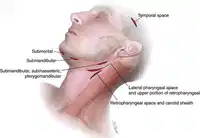
A 32-year-old man presents with fever, trismus, and a firm lateral pharyngeal wall bulge. CT shows an abscess tracking from a mandibular second molar into parapharyngeal space.
Which is the preferred site for surgical drainage of this abscess?
Transcervical incision through the tonsillar fossa
Transcervical incision along the anterior border of the sternocleidomastoid
Submandibular incision at the angle of the mandible
Percutaneous drainage via posterior cervical triangle
Intraoral incision through the floor of mouth near the sublingual caruncle
Answer explanation
3.
MULTIPLE CHOICE QUESTION
45 sec • 10 pts
A patient presents with a rapidly spreading odontogenic infection that has progressed from a superficial dental abscess into deeper fascial spaces. The organism responsible is a facultative aerobe believed to initiate deep tissue spread by surviving in both oxygen-rich and oxygen-poor environments.
Which organism is most likely involved?
Bacteroides spp.
Prevotella spp.
Peptostreptococcus spp.
Viridans streptococci
Fusobacterium spp
4.
MULTIPLE CHOICE QUESTION
45 sec • 10 pts
A 56-year-old man reports a 3-month history of persistent, dull pain in the right posterior mandible, which has recently worsened acutely. He also notes numbness of the lower lip. Imaging shows patchy radiolucency with sclerotic areas and small isolated bone fragments, minimal soft tissue swelling.
What is the most likely diagnosis?
Acute submandibular abscess
Ludwig’s angina
Chronic suppurative osteomyelitis
Osteoradionecrosis
Masticator space infection
5.
MULTIPLE CHOICE QUESTION
45 sec • 10 pts
A patient with an untreated orbital infection develops fever, headache, periorbital edema, diplopia, and ophthalmoplegia. Fundoscopic examination reveals retinal venous congestion, including changes in the contralateral eye.
Which cranial nerve is most likely to be affected first?
Optic nerve
Oculomotor nerve
Trochlear nerve
Abducent nerve
Maxillary nerve
Answer explanation
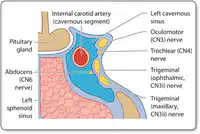
In cavernous sinus thrombosis, the abducent nerve is affected first because it lies centrally within the cavernous sinus and is most vulnerable to compression.
6.
MULTIPLE CHOICE QUESTION
45 sec • 10 pts
A 23-year-old man presents with trismus, mild drooling, pain behind the ear, and swelling along the posterior mandible after self-treating dental pain with herbal compresses. CT shows a collection between the mandible and medial pterygoid extending posteriorly into the parotid fascia.
Which fascial space best describes this infection?
Submasseteric
Lateral pharyngeal
Pterygomandibular
Parapharyngeal
Retropharyngeal
Answer explanation
The pterygomandibular space is bounded:
· Laterally: the mandible
· Medially: the medial pterygoid muscle
1.Submasseteric: Located between the masseter and mandible (lateral), not medial pterygoid.
2. Lateral pharyngeal / D. Parapharyngeal:
Deep neck spaces medial to the mandible
3. Retropharyngeal: Lies posterior to the pharynx, between the buccopharyngeal fascia and alar fascia
7.
MULTIPLE CHOICE QUESTION
45 sec • 1 pt
SOLVE THIS: 5+ 5 x 5 =
50
30
25
10
Access all questions and much more by creating a free account
Create resources
Host any resource
Get auto-graded reports

Continue with Google

Continue with Email

Continue with Classlink

Continue with Clever
or continue with

Microsoft
%20(1).png)
Apple

Others
Already have an account?


