
1.4 Types of Data: Primary vs Secondary
Authored by Budin Ajak
Engineering
University


AI Actions
Add similar questions
Adjust reading levels
Convert to real-world scenario
Translate activity
More...
Content View
Student View
10 questions
Show all answers
1.
MULTIPLE CHOICE QUESTION
30 sec • 1 pt
A research team must decide between collecting new measurements themselves or using an existing dataset. Which choice most effectively balances timeliness and awareness of limitations against cost and effort?
Use outdated public reports to save more time
Combine secondary summaries without checking meanings
Rely on secondary data compiled by another source
Use primary data collected with a tailored method
2.
MULTIPLE CHOICE QUESTION
30 sec • 1 pt
A university team wants to study lecturers’ motivation and distributes questionnaires to a sampled list of lecturers they compiled. Which data type are they collecting, and why?
Primary data, derived from historical archives and reports
Secondary data, gathered by interviewing third-party analysts
Primary data, collected directly from sampled respondents
Secondary data, extracted from existing institutional records
3.
MULTIPLE CHOICE QUESTION
30 sec • 1 pt
An engineer has a homogenous population of 900 sensors listed in a sampling frame. She needs a sample of 30 using Simple Random Sampling. Which approach best ensures each sensor has an equal chance of selection?
Select sensors from one factory line
Choose first 30 sensors on list
Pick every 30th sensor from list
Draw 30 labels from a sealed box
4.
MULTIPLE CHOICE QUESTION
30 sec • 1 pt
A factory has a population of N = 1,200 units and needs a sample of n = 60 using systematic random sampling. Which first step correctly sets up the sampling interval k and why?
Set k = 60 because the sample size equals interval
Compute k = n/N = 0.05 to space selections evenly
Compute k = N/n = 20 to space selections evenly
Choose k arbitrarily between 1 and 60 for flexibility
5.
MULTIPLE CHOICE QUESTION
30 sec • 1 pt
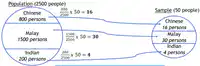
A city has 12,000 residents divided into three strata: 7,200 engineers, 3,600 technicians, and 1,200 managers. You plan a stratified random sample of 240 people using proportional allocation. How many technicians should be included?
80 technicians selected proportionally
72 technicians selected proportionally
60 technicians selected proportionally
48 technicians selected proportionally
6.
MULTIPLE CHOICE QUESTION
30 sec • 1 pt
Which statement best describes the design principle of stratified random sampling when forming strata?
Strata and elements both uniformly heterogeneous everywhere
Strata internally heterogeneous, population across strata homogeneous
Strata internally homogeneous, population across strata heterogeneous
Strata randomly formed without considering characteristics
7.
MULTIPLE CHOICE QUESTION
30 sec • 1 pt
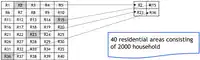
A city has 40 residential areas, each with 50 households. To select a sample of 200 households efficiently, which design best matches cluster sampling and why?
Divide areas into strata and sample some households from each
Randomly pick 200 households across all areas proportionally
Select 4 areas randomly and survey all households in those areas
Systematically choose every 10th household across the entire city
Access all questions and much more by creating a free account
Create resources
Host any resource
Get auto-graded reports

Continue with Google

Continue with Email

Continue with Classlink

Continue with Clever
or continue with

Microsoft
%20(1).png)
Apple

Others
Already have an account?

