
Plate Tectonics & Volcano Quiz Review
Authored by NICOLE CLARKE
Science
10th Grade
NGSS covered
Used 2+ times


AI Actions
Add similar questions
Adjust reading levels
Convert to real-world scenario
Translate activity
More...
Content View
Student View
20 questions
Show all answers
1.
MULTIPLE CHOICE QUESTION
30 sec • 1 pt
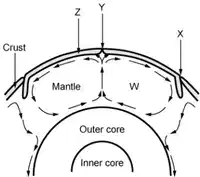
In the diagram of Earth’s layers, point X is at a plate boundary with downward arrows into the mantle. Which process is most directly occurring at point X?
Uplift of continental crust by isostasy
Lateral transform motion between plates
Subduction of a denser tectonic plate
Sea-floor spreading at mid-ocean ridge
Tags
NGSS.MS-ESS2-3
NGSS.MS-ESS2-2
2.
MATCH QUESTION
30 sec • 1 pt
Match each tectonic force with its primary description shown in the plate movement model.
Mid-ocean ridge
Continental Plates Collide
Mountain
Continental Plates Separate
Trench
Oceanic Plates Separate
Rift Valley
Oceanic Plates Collide
Tags
NGSS.MS-ESS2-3
3.
MULTIPLE CHOICE QUESTION
30 sec • 1 pt
Which statement best explains why iron is solid in the inner core but liquid in the outer core?
Lower temperature in the outer core freezes the iron
Higher pressure in the inner core keeps iron solid
Lower pressure in the inner core keeps iron liquid
Higher temperature in the inner core melts the iron
Tags
NGSS.MS-PS1-4
4.
MULTIPLE CHOICE QUESTION
30 sec • 1 pt
What process moves thermal energy through the mantle, causing magma to rise and sink?
Conduction by direct contact
Advection across the crust
Radiation through empty space
Convection within the mantle
Tags
NGSS.HS-ESS2-3
5.
MULTIPLE CHOICE QUESTION
30 sec • 1 pt
At a convergent boundary between an oceanic plate and a continental plate, what most likely occurs?
Earthquakes in the middle of the ocean
Oceanic plate subducts beneath continental
Continental plate subducts beneath oceanic
Plates push equally, forming block mountains
Tags
NGSS.HS-ESS1-5
NGSS.HS-ESS2-1
6.
MULTIPLE CHOICE QUESTION
30 sec • 1 pt
Which type of tectonic plate boundary is most likely responsible for the formation of large (folded) mountain ranges near a coast?
Two continental plates collide
Oceanic plate subducts beneath oceanic
Oceanic plate subducts beneath continental
Two oceanic plates diverge
Tags
NGSS.HS-ESS1-5
NGSS.HS-ESS2-1
7.
MULTIPLE CHOICE QUESTION
30 sec • 1 pt
Geologists examining a mountain range observe the presence of folded rock layers, including both anticlines and synclines. What does this evidence most likely suggest about the geological processes that shaped the mountain range?
It was formed by the compression of Earth’s crust due to tectonic plate movement.
It was formed by the melting and solidification of magma at the surface.
It was formed by the accumulation of wind-blown sand over time.
It was formed by the erosion of rocks by running water.
Tags
NGSS.HS-ESS1-5
NGSS.HS-ESS2-1
Access all questions and much more by creating a free account
Create resources
Host any resource
Get auto-graded reports

Continue with Google

Continue with Email

Continue with Microsoft
or continue with

%20(1).png)
Apple

Others
By signing up, you agree to our Terms of Service & Privacy Policy
Already have an account?


