
Why AI Fails and How it Responds
Authored by Rajendren Subramaniam
Computers
University


AI Actions
Add similar questions
Adjust reading levels
Convert to real-world scenario
Translate activity
More...
Content View
Student View
30 questions
Show all answers
1.
MULTIPLE CHOICE QUESTION
30 sec • 1 pt
In the image titled “Why AI Feels Smart but Fails,” which root cause links generic answers, wrong assumptions, and shallow results?
Lack of training data variety
Overuse of technical jargon
Unclear prompts from the user
Excessive computational precision
2.
MULTIPLE CHOICE QUESTION
30 sec • 1 pt
You must design a prompt that leverages how the system responds. Based on the image titled “How AI Responds,” which strategy best improves output quality?
Request broad creativity without limits
Provide strict structure and clear constraints
Avoid patterns to prevent bias
Rely on the model’s built-in context memory
3.
MULTIPLE CHOICE QUESTION
30 sec • 1 pt
In the diagram showing "Blind Prompts," which characteristic best defines them?
Constraints such as length or tone
Goal documented and measurable
Vague with little guidance
Specific role and task given
4.
MULTIPLE CHOICE QUESTION
30 sec • 1 pt
You need a prompt that yields a targeted, consistent output from an AI. According to the figure on "Precision Prompts," which element is essential to include?
Open-ended topic only
Undefined audience context
Clear role with constraints
Free-form brainstorming request
5.
MULTIPLE CHOICE QUESTION
30 sec • 1 pt
Which prompt technique assigns a specific professional identity to the assistant to guide responses?
Role prompting with expert identity
Rubber ducking for self-explanation
Feature blueprinting with bullets
Explicit context setup for clarity
6.
MULTIPLE CHOICE QUESTION
30 sec • 1 pt
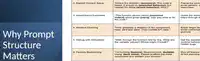
What is the primary goal of iterative chaining when working with complex coding tasks?
Create emotional buy-in for tasks
Break work into sequenced steps
Copy an expert’s exact style
Simulate runtime variable values
7.
MULTIPLE CHOICE QUESTION
30 sec • 1 pt
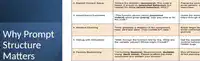
Which approach demonstrates intent through examples by showing expected outputs for given inputs?
Input/Output examples prompting
Constraint anchoring directives
Code refactor guidance notes
Ask for alternatives style
Access all questions and much more by creating a free account
Create resources
Host any resource
Get auto-graded reports

Continue with Google

Continue with Email

Continue with Classlink

Continue with Clever
or continue with

Microsoft
%20(1).png)
Apple

Others
Already have an account?


