
Systems Test Study Guide
Authored by Alyssa Black
Mathematics
9th Grade
CCSS covered
Used 4+ times


AI Actions
Add similar questions
Adjust reading levels
Convert to real-world scenario
Translate activity
More...
Content View
Student View
68 questions
Show all answers
1.
MULTIPLE CHOICE QUESTION
2 mins • 1 pt
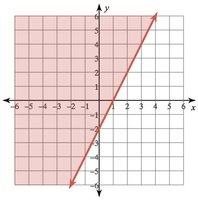
Which point below is NOT part of the solution set?
(0, -2)
(1, 1)
(3, 3)
(2, 10)
Answer explanation
The point (3, 3) does not satisfy the equation or condition defined by the solution set, making it the only point that is not part of the solution. The other points (0, -2), (1, 1), and (2, 10) are valid solutions.
2.
MULTIPLE CHOICE QUESTION
2 mins • 1 pt

Which point below is NOT part of the solution set?
(3, 4)
(0, 4)
(-2, 6)
(6, 2)
Answer explanation
The point (0, 4) does not satisfy the conditions of the solution set, while (3, 4), (-2, 6), and (6, 2) do. Therefore, (0, 4) is the correct answer as it is NOT part of the solution set.
Tags
CCSS.HSA.REI.D.12
3.
MULTIPLE CHOICE QUESTION
2 mins • 1 pt
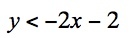
Is (-1, 0) a solution to this inequality?
Yes
No
Answer explanation
To determine if (-1, 0) is a solution, substitute -1 for x and 0 for y in the inequality. If the inequality does not hold true, then (-1, 0) is not a solution. Thus, the correct answer is No.
4.
MULTIPLE CHOICE QUESTION
2 mins • 1 pt

Is (1, 6) a solution to this inequality?
Yes
No
Answer explanation
To determine if (1, 6) is a solution, substitute x=1 and y=6 into the inequality. If the inequality holds true, then (1, 6) is a solution. Since it satisfies the inequality, the answer is Yes.
5.
MULTIPLE CHOICE QUESTION
2 mins • 1 pt
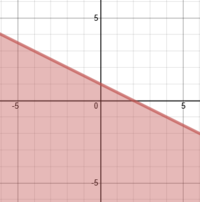
Are the points on the boundary line part of the solution set or not?
Yes, they are part of the solution set
No, they are NOT part of the solution set
Answer explanation
Yes, the points on the boundary line are part of the solution set when the inequality is inclusive (e.g., ≤ or ≥). This means that the boundary points satisfy the equation and are included in the solution.
Tags
CCSS.HSA.REI.D.12
6.
MULTIPLE CHOICE QUESTION
2 mins • 1 pt
Which of the following ordered pairs is a solution of the inequality 3x + 2y > 1?
( -1, -5 )
( -5, 4 )
( -6, 0 )
( 2, 4 )
Answer explanation
To check which pair satisfies 3x + 2y > 1, substitute each pair. For (2, 4): 3(2) + 2(4) = 6 + 8 = 14 > 1. Thus, (2, 4) is a solution. The other pairs do not satisfy the inequality.
7.
MULTIPLE CHOICE QUESTION
2 mins • 1 pt
Justin charges $11 to mow a small lawn and $26 to mow a large lawn. He would like to make at least $130.
Write an inequality that describes the situation.
Let x = # of small lawns mowed and
Let y = # of large lawns mowed
11x + 26y ≥ 130
11x + 26y > 130
11x + 26y ≤ 130
11x + 26y < 130
Answer explanation
Justin's earnings from mowing small and large lawns can be represented as 11x + 26y. To ensure he makes at least $130, we use the inequality 11x + 26y ≥ 130, making this the correct choice.


Access all questions and much more by creating a free account
Create resources
Host any resource
Get auto-graded reports

Continue with Google

Continue with Email

Continue with Microsoft
or continue with

%20(1).png)
Apple

Others
Already have an account?


