
Reflection and Refraction Quiz
Authored by Akira Wingo
Geography
10th Grade
Used 1+ times


AI Actions
Add similar questions
Adjust reading levels
Convert to real-world scenario
Translate activity
More...
Content View
Student View
10 questions
Show all answers
1.
MULTIPLE CHOICE QUESTION
30 sec • 1 pt
Which best describes reflection and refraction?
In both reflection and refraction, rays pass through a boundary.
In both reflection and refraction, rays bounce off a boundary.
In reflection, rays bounce off a boundary, and in refraction, rays pass through a boundary.
In refraction, rays bounce off a boundary, and in reflection, rays pass through a boundary.
2.
MULTIPLE CHOICE QUESTION
30 sec • 1 pt
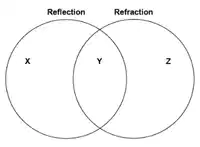
Serena draws the diagram above to compare what happens when rays hit a boundary and are either reflected or refracted. Which labels belong in the areas marked X, Y, and Z?
X: ray bounces off a boundary and maintains constant speed Y: ray changes direction Z: ray passes through a boundary and changes speed
X: ray bounces off a boundary and changes speed Y: ray changes direction Z: ray passes through a boundary and maintains constant speed
X: ray bounces off a boundary and changes direction Y: ray maintains constant speed Z: ray passes through a boundary and does not change direction
X: ray bounces off a boundary and does not change direction Y: ray maintains constant speed Z: ray passes through a boundary and changes direction
3.
MULTIPLE CHOICE QUESTION
30 sec • 1 pt
Which statement describes how rays behave when they travel through media during reflection and refraction?
During refraction, rays stay in the original medium, and during reflection, rays pass into a new medium.
During reflection, rays stay in the original medium, and during refraction, rays pass into a new medium.
During reflection and refraction, rays stay in the original medium.
During reflection and refraction, rays pass into a new medium.
4.
MULTIPLE CHOICE QUESTION
30 sec • 1 pt
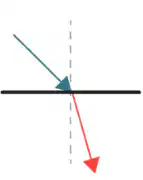
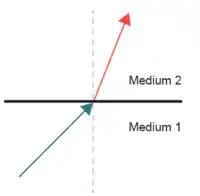
Which best explains why the diagram shows refraction but not reflection?
A. It shows an incident ray.
B. It shows that the ray is changing direction.
C. It shows the ray passing through the boundary.
D. It shows that angles form between the rays and the normal.
5.
MULTIPLE CHOICE QUESTION
30 sec • 1 pt
Light strikes a smooth wooden tabletop. What happens to the light after it is reflected?
The light rays bounce off the table and all move in the same direction.
The light rays bounce off the table and move in different directions.
The light rays pass through the table and all move in the same direction.
The light rays pass through the table and move in different directions.
6.
MULTIPLE CHOICE QUESTION
30 sec • 1 pt
A ray of light strikes a smooth surface and is reflected. The angle of incidence is 35°. What can be predicted about the angle of reflection?
Rays will bounce in all directions, so the angle of reflection will be random.
Rays will bounce in all directions, so the angle of reflection will be less than 35°.
Rays will follow the law of reflection, so the angle of reflection will be 35°.
Rays will follow the law of reflection, so the angle of reflection will be random.
7.
MULTIPLE CHOICE QUESTION
30 sec • 1 pt
Which formula represents Snell’s law?
n₁ + sinθ₁ = n₂ + sinθ₂
n₁sinθ₁ = n₂sinθ₂
n₁cosθ₁ = n₂cosθ₂
n₁ + cosθ₁ = n₂ + cosθ₂
Access all questions and much more by creating a free account
Create resources
Host any resource
Get auto-graded reports

Continue with Google

Continue with Email

Continue with Classlink

Continue with Clever
or continue with

Microsoft
%20(1).png)
Apple

Others
Already have an account?


