
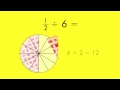
Dividing Fractions by Whole Numbers: A Comprehensive Guide

Interactive Video
•
Mathematics
•
6th - 10th Grade
•
Practice Problem
•
Hard
+3
Standards-aligned

Mia Campbell
FREE Resource
Standards-aligned
8 questions
Show all answers
1.
MULTIPLE CHOICE QUESTION
30 sec • 1 pt
What is the problem discussed in the video?
Subtracting six from one-half
Adding one-half to six
Multiplying one-half by six
Dividing one-half by six
Tags
CCSS.7.EE.B.3
2.
MULTIPLE CHOICE QUESTION
30 sec • 1 pt
What is used to visualize the problem of dividing one-half by six?
A quarter of a blueberry pie
A half-eaten cherry pie
A whole chocolate cake
A whole apple pie
Tags
CCSS.5.NF.B.3
3.
MULTIPLE CHOICE QUESTION
30 sec • 1 pt
How many equal parts are there in the whole pie if half contains six equal parts?
10
12
8
6
Tags
CCSS.1.G.A.3
4.
MULTIPLE CHOICE QUESTION
30 sec • 1 pt
How much of the whole pie will each of the six people get?
1/6
1/12
1/8
1/10
Tags
CCSS.5.NF.B.3
5.
MULTIPLE CHOICE QUESTION
30 sec • 1 pt
What is the reciprocal of a whole number?
The same number
The number multiplied by 2
The number divided by 2
1 divided by the number
6.
MULTIPLE CHOICE QUESTION
30 sec • 1 pt
What operation is used instead of division when working with fractions?
Addition
Subtraction
Multiplication
Exponentiation
Tags
CCSS.6.NS.A.1
7.
MULTIPLE CHOICE QUESTION
30 sec • 1 pt
Why does the trick of using the reciprocal work?
Because addition and subtraction are inverse operations
Because multiplication and division are inverse operations
Because it simplifies the equation
Because fractions are always less than whole numbers
Tags
CCSS.7.NS.A.2C
Access all questions and much more by creating a free account
Create resources
Host any resource
Get auto-graded reports

Continue with Google

Continue with Email

Continue with Classlink

Continue with Clever
or continue with

Microsoft
%20(1).png)
Apple

Others
Already have an account?

