
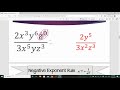
Exploring Zero and Negative Exponent Laws

Interactive Video
•
Mathematics
•
6th - 10th Grade
•
Practice Problem
•
Medium
Standards-aligned

Emma Peterson
Used 2+ times
FREE Resource
Standards-aligned
10 questions
Show all answers
1.
MULTIPLE CHOICE QUESTION
30 sec • 1 pt
What is the value of any number raised to the power of zero?
0
Undefined
The number itself
1
Tags
CCSS.8.EE.A.1
2.
MULTIPLE CHOICE QUESTION
30 sec • 1 pt
If a term has a zero exponent, what does it simplify to?
The term itself
1
0
Undefined
Tags
CCSS.8.EE.A.1
3.
MULTIPLE CHOICE QUESTION
30 sec • 1 pt
In the expression (a^4 c^2 e^0), what is the simplified form?
(a^4 c^2)
(a^4 c^2 e^0)
(c^2 e^0)
(a^4 e^0)
Tags
CCSS.6.EE.A.1
4.
MULTIPLE CHOICE QUESTION
30 sec • 1 pt
What happens to a term with a zero exponent in a fraction?
It remains in the fraction
It becomes zero
It becomes one
It is removed from the fraction
Tags
CCSS.8.EE.A.1
5.
MULTIPLE CHOICE QUESTION
30 sec • 1 pt
What is the rule for handling negative exponents?
They become positive when moved across the fraction bar
They are removed
They become zero
They remain negative
Tags
CCSS.8.EE.A.1
6.
MULTIPLE CHOICE QUESTION
30 sec • 1 pt
How do you simplify (3^-2)?
1/(3^2)
1/3
(3^2)
3
Tags
CCSS.8.EE.A.1
7.
MULTIPLE CHOICE QUESTION
30 sec • 1 pt
In the expression (4x^-2), where does the (x^-2) term move to?
It is removed
It becomes zero
It moves to the denominator
It stays in the numerator
Tags
CCSS.8.EE.A.1
Access all questions and much more by creating a free account
Create resources
Host any resource
Get auto-graded reports

Continue with Google

Continue with Email

Continue with Microsoft
or continue with

%20(1).png)
Apple

Others
By signing up, you agree to our Terms of Service & Privacy Policy
Already have an account?

