
- Resource Library
- Science
- Chemistry
- Separation Methods
- Techniques For Separating Mixtures In The Laboratory
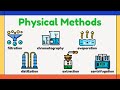
Techniques for Separating Mixtures in the Laboratory

Interactive Video
•
Science
•
6th - 10th Grade
•
Practice Problem
•
Hard
Standards-aligned

Sophia Harris
FREE Resource
Standards-aligned
Read more
10 questions
Show all answers
1.
MULTIPLE CHOICE QUESTION
30 sec • 1 pt
What is a mixture?
Two or more substances physically combined
Two or more substances chemically bonded
A single substance
A substance that cannot be separated
2.
MULTIPLE CHOICE QUESTION
30 sec • 1 pt
Which of the following is an example of a heterogeneous mixture?
Salt water
Air
Pizza
Vinegar
3.
MULTIPLE CHOICE QUESTION
30 sec • 1 pt
What is the purpose of filtration?
To separate insoluble solids from liquids
To separate soluble solids from liquids
To separate liquids from gases
To separate two immiscible liquids
4.
MULTIPLE CHOICE QUESTION
30 sec • 1 pt
In centrifugation, what happens to denser particles?
They evaporate
They are forced to the bottom
They dissolve in the liquid
They stay at the top
5.
MULTIPLE CHOICE QUESTION
30 sec • 1 pt
What is the mobile phase in chromatography?
A solid
A liquid or gas
A piece of chromatography paper
A stationary phase
6.
MULTIPLE CHOICE QUESTION
30 sec • 1 pt
What does a higher RF value indicate in chromatography?
Highly soluble pigments
Less soluble pigments
Larger pigments
Smaller pigments
7.
MULTIPLE CHOICE QUESTION
30 sec • 1 pt
What is the main principle behind evaporation?
Using a filter to separate solids from liquids
Heating a mixture to separate two liquids
Cooling a mixture to separate two solids
Heating a mixture to turn a liquid into gas
Tags
NGSS.MS-PS1-4
Access all questions and much more by creating a free account
Create resources
Host any resource
Get auto-graded reports

Continue with Google

Continue with Email

Continue with Microsoft
or continue with

%20(1).png)
Apple

Others
By signing up, you agree to our Terms of Service & Privacy Policy
Already have an account?

