
Modeling Multiplication and Division with Tape Diagrams

Interactive Video
•
Mathematics
•
6th - 10th Grade
•
Practice Problem
•
Hard
+6
Standards-aligned

Mia Campbell
FREE Resource
Standards-aligned
Read more
10 questions
Show all answers
1.
MULTIPLE CHOICE QUESTION
30 sec • 1 pt
What operation is the inverse of multiplying a variable by 5?
Dividing the variable by 5
Adding 5 to the variable
Subtracting 5 from the variable
Multiplying the variable by 5 again
Tags
CCSS.6.EE.B.7
2.
MULTIPLE CHOICE QUESTION
30 sec • 1 pt
What is the result of dividing 45 by 5?
7
10
8
9
Tags
CCSS.4.NBT.B.6
3.
MULTIPLE CHOICE QUESTION
30 sec • 1 pt
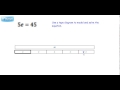
What does the tape diagram visually represent in the equation 5e=45?
The multiplication of 5 by 9
The division of 45 by 5
The addition of 9 five times
All of the above
Tags
CCSS.4.NBT.B.6
CCSS.5.NBT.B.6
4.
MULTIPLE CHOICE QUESTION
30 sec • 1 pt
How many parts does the tape diagram for 5e=45 divide into?
9 parts
45 parts
5 parts
10 parts
Tags
CCSS.4.NBT.B.6
CCSS.5.NBT.B.6
5.
MULTIPLE CHOICE QUESTION
30 sec • 1 pt
What does each part of the tape diagram for 5e=45 represent?
A value of 45
A value of 5
A value of 10
A value of 9
Tags
CCSS.4.NBT.B.6
6.
MULTIPLE CHOICE QUESTION
30 sec • 1 pt
What is the purpose of using a tape diagram in solving equations?
To complicate the solution process
To introduce new mathematical operations
To visually represent the algebraic solution
To replace algebraic methods
Tags
CCSS.8.EE.A.1
7.
MULTIPLE CHOICE QUESTION
30 sec • 1 pt
In the equation F/3=10, what operation is used to isolate F?
Addition
Subtraction
Division
Multiplication
Tags
CCSS.3.OA.A.4
Access all questions and much more by creating a free account
Create resources
Host any resource
Get auto-graded reports

Continue with Google

Continue with Email

Continue with Classlink

Continue with Clever
or continue with

Microsoft
%20(1).png)
Apple

Others
Already have an account?

