
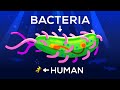
Exploring the Size Limits of Bacteria

Interactive Video
•
Biology
•
6th - 10th Grade
•
Practice Problem
•
Hard

Olivia Brooks
FREE Resource
Read more
10 questions
Show all answers
1.
MULTIPLE CHOICE QUESTION
30 sec • 1 pt
What is the primary function of cellular respiration?
To produce water
To consume carbon dioxide
To generate energy
To create oxygen
2.
MULTIPLE CHOICE QUESTION
30 sec • 1 pt
What physical law allows molecules to move from areas of high concentration to areas of low concentration?
Diffusion
The square-cube law
Osmosis
Gravity
3.
MULTIPLE CHOICE QUESTION
30 sec • 1 pt
What is the primary method of gas exchange in small organisms like bacteria?
Active transport
Diffusion
Endocytosis
Exocytosis
4.
MULTIPLE CHOICE QUESTION
30 sec • 1 pt
Why is diffusion not effective for large organisms?
Because it's too fast
Because of the square-cube law
Because it requires too much energy
Because large organisms do not have cells
5.
MULTIPLE CHOICE QUESTION
30 sec • 1 pt
What does the square-cube law imply for the size of living organisms?
Larger organisms have proportionally more surface area
Smaller organisms have proportionally more volume
Larger organisms have proportionally more volume
Surface area and volume increase at the same rate
6.
MULTIPLE CHOICE QUESTION
30 sec • 1 pt
What is the main reason multicellular organisms developed specialized cells?
To consume more food
To move faster
To increase their size
To improve diffusion efficiency
7.
MULTIPLE CHOICE QUESTION
30 sec • 1 pt
How do your lungs maximize the surface area for gas exchange?
By minimizing blood vessels
By having many tightly packed tiny balloons
By being small and compact
By being large and smooth
Access all questions and much more by creating a free account
Create resources
Host any resource
Get auto-graded reports

Continue with Google

Continue with Email

Continue with Microsoft
or continue with

%20(1).png)
Apple

Others
By signing up, you agree to our Terms of Service & Privacy Policy
Already have an account?


