
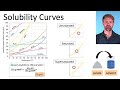
Solubility Curves: Key Concepts and Problem Solving

Interactive Video
•
Chemistry
•
6th - 10th Grade
•
Practice Problem
•
Medium

Emma Peterson
Used 2+ times
FREE Resource
10 questions
Show all answers
1.
MULTIPLE CHOICE QUESTION
30 sec • 1 pt
What is solubility?
The temperature at which a solute dissolves in a solvent
The mixture produced when a solute dissolves in a solvent
The process of a solute dissolving in a solvent
The maximum amount of solute that can dissolve in a given amount of solvent
2.
MULTIPLE CHOICE QUESTION
30 sec • 1 pt
How does temperature generally affect the solubility of solids in water?
Solubility does not change with temperature
Temperature has an unpredictable effect on solubility
Solubility increases as temperature increases
Solubility decreases as temperature increases
3.
MULTIPLE CHOICE QUESTION
30 sec • 1 pt
At what temperature does KCl have a solubility of 40 grams per 100 grams of water?
60 degrees Celsius
30 degrees Celsius
50 degrees Celsius
42 degrees Celsius
4.
MULTIPLE CHOICE QUESTION
30 sec • 1 pt
Which compound is most soluble at 40 degrees Celsius?
Sodium nitrate (NaNO3)
Calcium chloride (CaCl2)
Potassium chloride (KCl)
Potassium nitrate (KNO3)
5.
MULTIPLE CHOICE QUESTION
30 sec • 1 pt
Which compound is least soluble at 10 degrees Celsius?
Calcium chloride (CaCl2)
Cerium sulfate (Ce2(SO4)3)
Potassium sulfate (K2SO4)
Potassium nitrate (KNO3)
6.
MULTIPLE CHOICE QUESTION
30 sec • 1 pt
What type of solution can still dissolve more solute at a given temperature?
Soluble
Supersaturated
Saturated
Unsaturated
7.
MULTIPLE CHOICE QUESTION
30 sec • 1 pt
What type of solution contains more solute than is theoretically possible at a given temperature?
Saturated
Unsaturated
Supersaturated
Soluble
Access all questions and much more by creating a free account
Create resources
Host any resource
Get auto-graded reports

Continue with Google

Continue with Email

Continue with Microsoft
or continue with

%20(1).png)
Apple

Others
By signing up, you agree to our Terms of Service & Privacy Policy
Already have an account?


