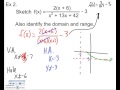
Exploring Adding and Subtracting Rational Expressions

Interactive Video
•
Mathematics
•
6th - 8th Grade
•
Practice Problem
•
Hard
Standards-aligned

Olivia Brooks
FREE Resource
Standards-aligned
10 questions
Show all answers
1.
MULTIPLE CHOICE QUESTION
30 sec • 1 pt
What distinguishes a rational function from a reciprocal function?
Non-zero denominator
Polynomials in the numerator only
Constant function behavior
Linear function transformation
Tags
CCSS.HSF-IF.C.7D
2.
MULTIPLE CHOICE QUESTION
30 sec • 1 pt
What creates a vertical asymptote in a rational function?
Both numerator and denominator are equal
Denominator equals zero
Numerator equals zero
Function does not have polynomials
Tags
CCSS.HSF-IF.C.7D
3.
MULTIPLE CHOICE QUESTION
30 sec • 1 pt
What results in a horizontal asymptote when the degree of the numerator is less than the degree of the denominator?
y = 0
y = 1
No horizontal asymptote
y = -1
Tags
CCSS.HSF-IF.C.7D
4.
MULTIPLE CHOICE QUESTION
30 sec • 1 pt
How do holes in the graph of a rational function occur?
When a factor in the numerator and denominator cancels out
When the numerator is zero
When the denominator is zero
When the function has no asymptotes
Tags
CCSS.HSF-IF.C.7D
5.
MULTIPLE CHOICE QUESTION
30 sec • 1 pt
What is the role of factoring in graphing rational functions?
To simplify the function
To create more asymptotes
To eliminate all variables
To determine the function's limits
Tags
CCSS.HSF-IF.C.7D
6.
MULTIPLE CHOICE QUESTION
30 sec • 1 pt
What does a horizontal asymptote at y = 3 indicate about the function?
The function crosses the y-axis at 3
The function approaches y = 3 as x approaches infinity
The degree of the numerator is three times the denominator
The function has a root at y = 3
Tags
CCSS.HSF-IF.C.7D
7.
MULTIPLE CHOICE QUESTION
30 sec • 1 pt
How can you determine the presence of a slant asymptote?
When the degree of the numerator is less than the denominator
When there are no polynomials in the function
When the degrees of the numerator and denominator are equal
When the degree of the numerator is greater than the denominator
Tags
CCSS.HSF-IF.C.7D
Access all questions and much more by creating a free account
Create resources
Host any resource
Get auto-graded reports

Continue with Google

Continue with Email

Continue with Classlink

Continue with Clever
or continue with

Microsoft
%20(1).png)
Apple

Others
Already have an account?
Popular Resources on Wayground

15 questions
Fractions on a Number Line

Quiz
•
3rd Grade
20 questions
Equivalent Fractions
Quiz
•
3rd Grade
25 questions
Multiplication Facts
Quiz
•
5th Grade
54 questions
Analyzing Line Graphs & Tables
Quiz
•
4th Grade
22 questions
fractions
Quiz
•
3rd Grade
20 questions
Main Idea and Details
Quiz
•
5th Grade
20 questions
Context Clues
Quiz
•
6th Grade
15 questions
Equivalent Fractions
Quiz
•
4th Grade
Discover more resources for Mathematics
22 questions
distributive property
Quiz
•
7th Grade
18 questions
Angle Relationships
Quiz
•
7th Grade
15 questions
Distributive Property & Review
Quiz
•
6th Grade
20 questions
Writing Algebraic Expressions
Quiz
•
6th Grade
20 questions
How Some Friendships Last — and Others Don’t Video Questions
Quiz
•
7th Grade
14 questions
finding slope from a graph
Quiz
•
8th Grade
20 questions
Ratios/Rates and Unit Rates
Quiz
•
6th Grade
18 questions
Handbook Refresher Quiz
Quiz
•
7th Grade