
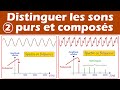
Understanding Pure and Complex Sounds

Interactive Video
•
Physics, Science
•
9th - 12th Grade
•
Practice Problem
•
Hard

Jackson Turner
FREE Resource
Read more
10 questions
Show all answers
1.
MULTIPLE CHOICE QUESTION
30 sec • 1 pt
What is a pure sound associated with?
A random noise signal
A square wave signal
A triangular wave signal
A sinusoidal signal
2.
MULTIPLE CHOICE QUESTION
30 sec • 1 pt
How can you identify a pure sound from its signal?
It is a square wave signal
It is a sinusoidal signal
It is a non-periodic signal
It is a triangular signal
3.
MULTIPLE CHOICE QUESTION
30 sec • 1 pt
What appears on the spectrum of a pure sound?
No peaks
Multiple peaks
A single peak
Random peaks
4.
MULTIPLE CHOICE QUESTION
30 sec • 1 pt
What is the frequency at the base of the peak in a pure sound spectrum called?
Fundamental frequency
Peak frequency
Harmonic frequency
Base frequency
5.
MULTIPLE CHOICE QUESTION
30 sec • 1 pt
What is a complex sound associated with?
A sinusoidal signal
A non-sinusoidal signal
A square wave signal
A random noise signal
6.
MULTIPLE CHOICE QUESTION
30 sec • 1 pt
What is the fundamental frequency of a complex sound with a fundamental of 500 Hz?
500 Hz
1500 Hz
2000 Hz
1000 Hz
7.
MULTIPLE CHOICE QUESTION
30 sec • 1 pt
What are the additional peaks in the spectrum of a complex sound called?
Subharmonics
Overtones
Harmonics
Fundamentals
Access all questions and much more by creating a free account
Create resources
Host any resource
Get auto-graded reports

Continue with Google

Continue with Email

Continue with Microsoft
or continue with

%20(1).png)
Apple

Others
By signing up, you agree to our Terms of Service & Privacy Policy
Already have an account?

