
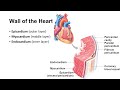
Heart Anatomy and Function Assessment

Interactive Video
•
Biology, Science
•
9th - 12th Grade
•
Practice Problem
•
Hard

Mia Campbell
FREE Resource
Read more
10 questions
Show all answers
1.
MULTIPLE CHOICE QUESTION
30 sec • 1 pt
Which layer of the heart is the outermost?
Endocardium
Myocardium
Pericardium
Epicardium
2.
MULTIPLE CHOICE QUESTION
30 sec • 1 pt
What is the primary function of the myocardium?
Regulating blood flow
Pumping blood through the body
Producing hormones
Protecting the heart
3.
MULTIPLE CHOICE QUESTION
30 sec • 1 pt
What type of tissue makes up the epicardium?
Connective tissue
Cardiac muscle tissue
Endothelial tissue
Nervous tissue
4.
MULTIPLE CHOICE QUESTION
30 sec • 1 pt
Which cells in the epicardium are responsible for generating electrical impulses?
Fibroblasts
Pacemaker cells
Endothelial cells
Cardiac muscle cells
5.
MULTIPLE CHOICE QUESTION
30 sec • 1 pt
What is the main role of fibroblasts in the epicardium?
Generating electrical impulses
Producing collagen and extracellular matrix proteins
Maintaining heart valves
Regulating blood flow
6.
MULTIPLE CHOICE QUESTION
30 sec • 1 pt
What are intercalated discs in the myocardium responsible for?
Connecting cardiac muscle cells for coordinated contractions
Regulating blood flow
Producing hormones
Generating electrical impulses
7.
MULTIPLE CHOICE QUESTION
30 sec • 1 pt
Which arteries supply the myocardium with oxygen and nutrients?
Coronary arteries
Aortic arteries
Carotid arteries
Pulmonary arteries
Access all questions and much more by creating a free account
Create resources
Host any resource
Get auto-graded reports

Continue with Google

Continue with Email

Continue with Microsoft
or continue with

%20(1).png)
Apple

Others
By signing up, you agree to our Terms of Service & Privacy Policy
Already have an account?

