
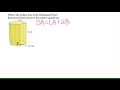
Calculating Surface Area of a Hexagonal Prism

Interactive Video
•
Mathematics
•
6th - 10th Grade
•
Practice Problem
•
Hard
+1
Standards-aligned

Mia Campbell
FREE Resource
Standards-aligned
Read more
10 questions
Show all answers
1.
MULTIPLE CHOICE QUESTION
30 sec • 1 pt
How many bases does a prism have?
4
3
2
1
Tags
CCSS.7.G.B.6
2.
MULTIPLE CHOICE QUESTION
30 sec • 1 pt
What is the formula for the surface area of a prism?
Surface Area = Lateral Area - Base Area
Surface Area = Base Area / Lateral Area
Surface Area = 2 * Base Area + Lateral Area
Surface Area = Base Area + Lateral Area
Tags
CCSS.7.G.B.6
3.
MULTIPLE CHOICE QUESTION
30 sec • 1 pt
How do you calculate the perimeter of the base in a hexagonal prism?
Add all sides
Multiply the base area by 6
Divide the height by 6
Multiply one side by 6
Tags
CCSS.7.G.B.6
4.
MULTIPLE CHOICE QUESTION
30 sec • 1 pt
What is the lateral area of the prism?
288 cm²
216 cm²
72 cm²
144 cm²
Tags
CCSS.7.G.B.6
5.
MULTIPLE CHOICE QUESTION
30 sec • 1 pt
How is the height of the prism identified?
Area of the base times 2
Distance between the two bases
Length of one side of the base
Perimeter of the base divided by 6
Tags
CCSS.1.G.A.1
CCSS.2.G.A.1
6.
MULTIPLE CHOICE QUESTION
30 sec • 1 pt
What is the height of the prism?
7 cm
8 cm
9 cm
6 cm
Tags
CCSS.7.G.B.6
7.
MULTIPLE CHOICE QUESTION
30 sec • 1 pt
What formula is used to calculate the area of the base in a hexagonal prism?
Area = 1/2 * base * height
Area = base * height
Area = 6 * (1/2 * base * height)
Area = 2 * (1/2 * base * height)
Tags
CCSS.7.G.B.6
Access all questions and much more by creating a free account
Create resources
Host any resource
Get auto-graded reports

Continue with Google

Continue with Email

Continue with Classlink

Continue with Clever
or continue with

Microsoft
%20(1).png)
Apple

Others
Already have an account?

