
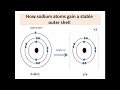
Understanding Atomic Stability and Ions

Interactive Video
•
Chemistry, Science
•
9th - 12th Grade
•
Practice Problem
•
Hard

Mia Campbell
FREE Resource
Read more
10 questions
Show all answers
1.
MULTIPLE CHOICE QUESTION
30 sec • 1 pt
What is the analogy used to describe how atoms behave?
Atoms behave like machines.
Atoms behave like humans seeking stability.
Atoms behave like plants growing towards light.
Atoms behave like animals hunting for food.
2.
MULTIPLE CHOICE QUESTION
30 sec • 1 pt
How many electrons does a sodium atom have in its outer shell?
Two electrons
Eight electrons
One electron
Three electrons
3.
MULTIPLE CHOICE QUESTION
30 sec • 1 pt
What happens to a sodium atom when it loses an electron?
It becomes a sodium atom with more electrons.
It becomes a neutral sodium atom.
It becomes a sodium ion with a positive charge.
It becomes a sodium ion with a negative charge.
4.
MULTIPLE CHOICE QUESTION
30 sec • 1 pt
Why are atoms in the universe generally neutral?
Because they have more electrons than protons.
Because they have more protons than electrons.
Because they have equal numbers of protons and electrons.
Because they have no protons or electrons.
5.
MULTIPLE CHOICE QUESTION
30 sec • 1 pt
What is the charge of a sodium ion after losing an electron?
Positive two
Zero
Positive one
Negative one
6.
MULTIPLE CHOICE QUESTION
30 sec • 1 pt
How does a chlorine atom achieve a stable outer shell?
By gaining a proton
By gaining an electron
By losing a proton
By losing an electron
7.
MULTIPLE CHOICE QUESTION
30 sec • 1 pt
What is the charge of a chloride ion?
Positive one
Positive two
Negative one
Zero
Access all questions and much more by creating a free account
Create resources
Host any resource
Get auto-graded reports

Continue with Google

Continue with Email

Continue with Microsoft
or continue with

%20(1).png)
Apple

Others
Already have an account?

