
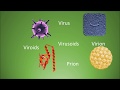
Microbiology: Viruses, Viroids, and Prions

Interactive Video
•
Biology, Science
•
7th - 10th Grade
•
Practice Problem
•
Easy

Jackson Turner
Used 1+ times
FREE Resource
Read more
8 questions
Show all answers
1.
MULTIPLE CHOICE QUESTION
30 sec • 1 pt
What is the main topic discussed in the video?
The lifecycle of bacteria
Differences among viruses, viroids, virusoids, and prions
The structure of human cells
The history of microbiology
2.
MULTIPLE CHOICE QUESTION
30 sec • 1 pt
What is a unique feature of viruses?
They are multicellular organisms
They can photosynthesize
They consist of either DNA or RNA as genetic material
They have a cell wall
3.
MULTIPLE CHOICE QUESTION
30 sec • 1 pt
What allows a virus to bind to its host?
Cell wall
Capsule
Chlorophyll
Membrane proteins
4.
MULTIPLE CHOICE QUESTION
30 sec • 1 pt
How do viroids differ from viruses?
Viroids can infect animals
Viroids are single-stranded RNA molecules without a capsule
Viroids are larger than viruses
Viroids have a protein coat
5.
MULTIPLE CHOICE QUESTION
30 sec • 1 pt
What is required for virusoids to replicate?
Autonomous replication
A host cell infected with a virus
Sunlight
A bacterial host
6.
MULTIPLE CHOICE QUESTION
30 sec • 1 pt
What is the nature of prions?
They are a type of bacteria
They are misfolded proteins
They are a type of virus
They are a form of RNA
7.
MULTIPLE CHOICE QUESTION
30 sec • 1 pt
How do prions cause disease?
By infecting plant cells
By triggering normal proteins to misfold
By replicating their DNA
By producing toxins
Access all questions and much more by creating a free account
Create resources
Host any resource
Get auto-graded reports

Continue with Google

Continue with Email

Continue with Classlink

Continue with Clever
or continue with

Microsoft
%20(1).png)
Apple

Others
Already have an account?

