
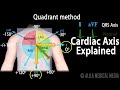
Understanding Cardiac Axis and QRS Complex

Interactive Video
•
Science, Biology
•
10th - 12th Grade
•
Practice Problem
•
Hard

Amelia Wright
FREE Resource
Read more
10 questions
Show all answers
1.
MULTIPLE CHOICE QUESTION
30 sec • 1 pt
What is the primary direction of the cardiac axis in a healthy heart?
Horizontally to the right
Downward and slightly left
Vertically upward
Upward and slightly right
2.
MULTIPLE CHOICE QUESTION
30 sec • 1 pt
In which condition does the cardiac axis deviate further to the left?
Atrial fibrillation
Right ventricular hypertrophy
Myocardial infarction
Left ventricular hypertrophy
3.
MULTIPLE CHOICE QUESTION
30 sec • 1 pt
What is the normal range for the QRS axis?
-90 to -30 degrees
-30 to +90 degrees
+90 to +180 degrees
-180 to -90 degrees
4.
MULTIPLE CHOICE QUESTION
30 sec • 1 pt
What type of deflection occurs when depolarization moves toward a lead?
Positive deflection
Isoelectric deflection
Negative deflection
No deflection
5.
MULTIPLE CHOICE QUESTION
30 sec • 1 pt
Which method involves analyzing the QRS complex in leads I and aVF?
Quadrant method
Bipolar lead method
Isoelectric lead method
Vector method
6.
MULTIPLE CHOICE QUESTION
30 sec • 1 pt
What does a positive QRS complex in both lead I and aVF indicate?
Normal axis
Extreme axis deviation
Right axis deviation
Left axis deviation
7.
MULTIPLE CHOICE QUESTION
30 sec • 1 pt
What does a negative QRS complex in both lead I and aVF suggest?
Extreme axis deviation
Right axis deviation
Normal axis
Left axis deviation
Access all questions and much more by creating a free account
Create resources
Host any resource
Get auto-graded reports

Continue with Google

Continue with Email

Continue with Microsoft
or continue with

%20(1).png)
Apple

Others
By signing up, you agree to our Terms of Service & Privacy Policy
Already have an account?

