
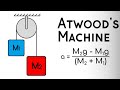
Atwood Machine Concepts and Misconceptions

Interactive Video
•
Physics, Mathematics
•
9th - 12th Grade
•
Practice Problem
•
Medium

Sophia Harris
Used 6+ times
FREE Resource
Read more
10 questions
Show all answers
1.
MULTIPLE CHOICE QUESTION
30 sec • 1 pt
What is the primary goal when analyzing an Atwood machine?
To determine the speed of the pulley
To find the acceleration of the blocks
To calculate the tension in the ceiling
To measure the length of the string
2.
MULTIPLE CHOICE QUESTION
30 sec • 1 pt
What does a free body diagram represent?
The speed of an object
The forces acting on an object
The color of an object
The temperature of an object
3.
MULTIPLE CHOICE QUESTION
30 sec • 1 pt
In a free body diagram, how is a large force typically represented?
With a large arrow
With a small arrow
With a dotted line
With a circle
4.
MULTIPLE CHOICE QUESTION
30 sec • 1 pt
According to Newton's Second Law, what is the net force on an object equal to?
The object's mass times its velocity
The object's speed
The object's mass times its acceleration
The object's weight
5.
MULTIPLE CHOICE QUESTION
30 sec • 1 pt
In the Atwood machine, why must the tensions on both ends of the string be the same?
Because the blocks are identical
Because the string is elastic
Because the pulley is frictionless
Because the forces must balance
6.
MULTIPLE CHOICE QUESTION
30 sec • 1 pt
What happens to the direction of positive motion in an Atwood machine?
It remains the same for both blocks
It switches from one side to the other
It is always upward
It is always downward
7.
MULTIPLE CHOICE QUESTION
30 sec • 1 pt
What is the final step in solving for the acceleration of the blocks in an Atwood machine?
Measuring the string length
Adjusting the pulley
Performing algebraic calculations
Drawing more diagrams
Access all questions and much more by creating a free account
Create resources
Host any resource
Get auto-graded reports

Continue with Google

Continue with Email

Continue with Classlink

Continue with Clever
or continue with

Microsoft
%20(1).png)
Apple

Others
Already have an account?

