
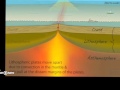
Seafloor Spreading Concepts

Interactive Video
•
Science
•
6th - 10th Grade
•
Practice Problem
•
Hard

Lucas Foster
FREE Resource
Read more
10 questions
Show all answers
1.
MULTIPLE CHOICE QUESTION
30 sec • 1 pt
What is the primary source of new ocean floor in the process of seafloor spreading?
Erosion of continental plates
Sediment accumulation
Deposition of marine organisms
Molten material from the mantle
2.
MULTIPLE CHOICE QUESTION
30 sec • 1 pt
Where does seafloor spreading primarily occur?
At ocean trenches
At mid-ocean ridges
On continental shelves
In deep ocean basins
3.
MULTIPLE CHOICE QUESTION
30 sec • 1 pt
What is the significance of the mid-ocean ridge in seafloor spreading?
It is a site of plate subduction
It is where new crust is formed
It is a location of high erosion
It is a boundary between continents
4.
MULTIPLE CHOICE QUESTION
30 sec • 1 pt
What role does magma play in the formation of new oceanic crust?
It erodes existing crust
It cools and solidifies to form new crust
It dissolves oceanic sediments
It compresses tectonic plates
5.
MULTIPLE CHOICE QUESTION
30 sec • 1 pt
What happens to the plates as they move apart during seafloor spreading?
They rise and form mountains
They become thinner
They sink into the mantle
They thicken and cool
6.
MULTIPLE CHOICE QUESTION
30 sec • 1 pt
What is the relationship between lava and magma in the context of seafloor spreading?
Lava and magma are the same
Lava is magma that remains underground
Lava is cooler than magma
Lava is magma that has reached the surface
7.
MULTIPLE CHOICE QUESTION
30 sec • 1 pt
How do convection currents in the mantle affect lithospheric plates?
They cause plates to rotate
They cause plates to move apart
They cause plates to merge
They cause plates to sink
Access all questions and much more by creating a free account
Create resources
Host any resource
Get auto-graded reports

Continue with Google

Continue with Email

Continue with Microsoft
or continue with

%20(1).png)
Apple

Others
By signing up, you agree to our Terms of Service & Privacy Policy
Already have an account?


