
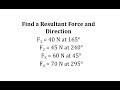
Understanding Resultant Force and Direction

Interactive Video
•
Mathematics, Physics, Science
•
9th - 12th Grade
•
Practice Problem
•
Hard

Emma Peterson
FREE Resource
Read more
10 questions
Show all answers
1.
MULTIPLE CHOICE QUESTION
30 sec • 1 pt
What is the first step in solving the problem of finding the resultant force and direction?
Calculate the angle of each vector
Find the inverse tangent of the vectors
Write each vector in component form
Determine the magnitude of each vector
2.
MULTIPLE CHOICE QUESTION
30 sec • 1 pt
How is the x-component of a vector calculated?
Magnitude divided by sine of the angle
Magnitude times cosine of the angle
Magnitude times sine of the angle
Magnitude divided by cosine of the angle
3.
MULTIPLE CHOICE QUESTION
30 sec • 1 pt
Which angle is used to calculate the y-component of the second force vector?
165 degrees
240 degrees
295 degrees
45 degrees
4.
MULTIPLE CHOICE QUESTION
30 sec • 1 pt
What is the approximate sum of the x-components to four decimal places?
10.8727
77.64
49.6335
50.83
5.
MULTIPLE CHOICE QUESTION
30 sec • 1 pt
What is the approximate sum of the y-components to four decimal places?
77.64
50.83
-49.6335
10.8727
6.
MULTIPLE CHOICE QUESTION
30 sec • 1 pt
How is the magnitude of the resultant vector calculated?
By using the square root of the sum of the squares of the components
By subtracting the y component from the x component
By multiplying the x and y components
By adding the x and y components
7.
MULTIPLE CHOICE QUESTION
30 sec • 1 pt
What is the magnitude of the resultant force rounded to two decimal places?
77.64
50.83
49.63
10.88
Access all questions and much more by creating a free account
Create resources
Host any resource
Get auto-graded reports

Continue with Google

Continue with Email

Continue with Classlink

Continue with Clever
or continue with

Microsoft
%20(1).png)
Apple

Others
Already have an account?


