
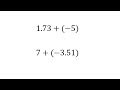
Understanding Sums with Different Signs

Interactive Video
•
Mathematics
•
6th - 8th Grade
•
Practice Problem
•
Hard
+2
Standards-aligned

Ethan Morris
FREE Resource
Standards-aligned
Read more
10 questions
Show all answers
1.
MULTIPLE CHOICE QUESTION
30 sec • 1 pt
What is the first step when adding numbers with different signs?
Divide the numbers
Add the numbers directly
Find the absolute values of both numbers
Multiply the numbers
Tags
CCSS.7.NS.A.1B
2.
MULTIPLE CHOICE QUESTION
30 sec • 1 pt
In the example 1.73 + (-5), which number has the larger absolute value?
Both have the same absolute value
1.73
-5
Cannot be determined
Tags
CCSS.6.NS.B.3
3.
MULTIPLE CHOICE QUESTION
30 sec • 1 pt
When subtracting 1.73 from 5, what is the result?
3.23
3.25
3.29
3.27
Tags
CCSS.7.NS.A.1C
4.
MULTIPLE CHOICE QUESTION
30 sec • 1 pt
Why is the sum of 1.73 + (-5) negative?
Because 1.73 is negative
Because -5 has a larger absolute value
Because both numbers are negative
Because 5 is positive
Tags
CCSS.7.NS.A.1B
5.
MULTIPLE CHOICE QUESTION
30 sec • 1 pt
How do you model the sum 1.73 + (-5) on a number line?
Move right 5 units, then left 1.73 units
Move left 1.73 units, then right 5 units
Move left 5 units, then right 1.73 units
Move right 1.73 units, then left 5 units
Tags
CCSS.6.NS.C.7C
6.
MULTIPLE CHOICE QUESTION
30 sec • 1 pt
In the second example, what is the absolute value of -3.51?
0
7
-3.51
3.51
Tags
CCSS.7.NS.A.1C
7.
MULTIPLE CHOICE QUESTION
30 sec • 1 pt
In the example 7 + (-3.51), what is the first step after finding absolute values?
Divide the numbers
Add the numbers
Subtract the smaller absolute value from the larger
Multiply the numbers
Tags
CCSS.5.NBT.B.7
Access all questions and much more by creating a free account
Create resources
Host any resource
Get auto-graded reports

Continue with Google

Continue with Email

Continue with Classlink

Continue with Clever
or continue with

Microsoft
%20(1).png)
Apple

Others
Already have an account?


