
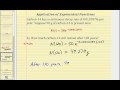
Carbon-14 Decay and Exponential Functions

Interactive Video
•
Mathematics, Science, Chemistry
•
10th - 12th Grade
•
Practice Problem
•
Hard

Aiden Montgomery
FREE Resource
Read more
10 questions
Show all answers
1.
MULTIPLE CHOICE QUESTION
30 sec • 1 pt
What is the general form of an exponential function with base e?
f(x) = a * k^x
f(x) = a * e^(kx)
f(x) = a * x^k
f(x) = a * e^(x/k)
2.
MULTIPLE CHOICE QUESTION
30 sec • 1 pt
In an exponential function with base e, what does a negative k value indicate?
Exponential growth
Linear decay
Exponential decay
Linear growth
3.
MULTIPLE CHOICE QUESTION
30 sec • 1 pt
What is the initial amount of carbon-14 in the given problem?
15 grams
20 grams
50 grams
100 grams
4.
MULTIPLE CHOICE QUESTION
30 sec • 1 pt
How is the continuous decay rate expressed as a decimal in the problem?
-0.012097
-0.00012097
0.012097
0.00012097
5.
MULTIPLE CHOICE QUESTION
30 sec • 1 pt
After 120 years, approximately how much carbon-14 remains?
49.279 grams
20 grams
50 grams
30 grams
6.
MULTIPLE CHOICE QUESTION
30 sec • 1 pt
What is the purpose of using a graphing calculator in the problem?
To find the initial amount
To determine the point of intersection
To calculate the decay rate
To convert percentages to decimals
7.
MULTIPLE CHOICE QUESTION
30 sec • 1 pt
What is the approximate age of the artifact if 20 grams of carbon-14 remain?
5000 years
7574.53 years
2000 years
10000 years
Access all questions and much more by creating a free account
Create resources
Host any resource
Get auto-graded reports

Continue with Google

Continue with Email

Continue with Classlink

Continue with Clever
or continue with

Microsoft
%20(1).png)
Apple

Others
Already have an account?


