
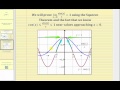
Understanding the Squeeze Theorem and Its Application

Interactive Video
•
Mathematics, Science
•
10th - 12th Grade
•
Practice Problem
•
Hard

Jackson Turner
FREE Resource
Read more
10 questions
Show all answers
1.
MULTIPLE CHOICE QUESTION
30 sec • 1 pt
What does the Squeeze Theorem state about the limits of functions f(x), g(x), and h(x)?
If f(x) is always greater than g(x), then the limit of f(x) is greater than the limit of g(x).
If f(x) is squeezed between g(x) and h(x), and the limits of g(x) and h(x) are equal, then the limit of f(x) is the same as those limits.
If f(x) is always less than h(x), then the limit of f(x) is less than the limit of h(x).
If f(x) is equal to g(x) at a point, then their limits are equal.
2.
MULTIPLE CHOICE QUESTION
30 sec • 1 pt
In the graphical explanation of the Squeeze Theorem, which function is represented by the blue line?
None of the above
f(x)
h(x)
g(x)
3.
MULTIPLE CHOICE QUESTION
30 sec • 1 pt
What is the significance of the functions g(x) and h(x) in the Squeeze Theorem?
They are always constant functions.
They must be equal to each other.
They provide bounds for f(x) to determine its limit.
They are irrelevant to the theorem.
4.
MULTIPLE CHOICE QUESTION
30 sec • 1 pt
What inequality is used to apply the Squeeze Theorem to sin(x)/x?
sin(x)/x is less than or equal to 0
sin(x)/x is greater than or equal to 1
sin(x)/x is greater than or equal to cos(x) and less than or equal to 1
sin(x)/x is equal to x
5.
MULTIPLE CHOICE QUESTION
30 sec • 1 pt
What is the limit of cos(x) as x approaches zero?
Undefined
Infinity
1
0
6.
MULTIPLE CHOICE QUESTION
30 sec • 1 pt
Why is the limit of sin(x)/x as x approaches zero equal to 1?
Because sin(x)/x is a constant function.
Because sin(x)/x is squeezed between cos(x) and 1, both of which have a limit of 1.
Because sin(x)/x is always greater than 1.
Because sin(x) is always equal to x.
7.
MULTIPLE CHOICE QUESTION
30 sec • 1 pt
What is the role of the open interval in the Squeeze Theorem?
It has no role in the theorem.
It ensures the functions are defined at the point of interest.
It restricts the functions to be constant.
It allows the functions to be undefined at the point of interest.
Access all questions and much more by creating a free account
Create resources
Host any resource
Get auto-graded reports

Continue with Google

Continue with Email

Continue with Classlink

Continue with Clever
or continue with

Microsoft
%20(1).png)
Apple

Others
Already have an account?
Popular Resources on Wayground

15 questions
Fractions on a Number Line

Quiz
•
3rd Grade
10 questions
Probability Practice
Quiz
•
4th Grade
15 questions
Probability on Number LIne
Quiz
•
4th Grade
20 questions
Equivalent Fractions
Quiz
•
3rd Grade
25 questions
Multiplication Facts
Quiz
•
5th Grade
22 questions
fractions
Quiz
•
3rd Grade
6 questions
Appropriate Chromebook Usage

Lesson
•
7th Grade
10 questions
Greek Bases tele and phon
Quiz
•
6th - 8th Grade
Discover more resources for Mathematics
23 questions
TSI Math Vocabulary
Quiz
•
10th - 12th Grade
10 questions
Plotting Points on a Coordinate Plane: Quadrant 1 Essentials
Interactive video
•
6th - 10th Grade
80 questions
ACT Math Important Vocabulary
Quiz
•
11th Grade
10 questions
Exploring Abiotic and Biotic Factors in Ecosystems
Interactive video
•
6th - 10th Grade
20 questions
SSS/SAS
Quiz
•
9th - 12th Grade
16 questions
Converting Improper Fractions to Mixed Numbers
Quiz
•
4th - 10th Grade
10 questions
Solving One Step Equations: Key Concepts and Techniques
Interactive video
•
6th - 10th Grade
10 questions
Special Right Triangles
Quiz
•
10th Grade