
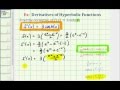
Derivatives of Exponential and Hyperbolic Functions

Interactive Video
•
Mathematics
•
10th - 12th Grade
•
Practice Problem
•
Hard
Standards-aligned

Mia Campbell
FREE Resource
Standards-aligned
Read more
10 questions
Show all answers
1.
MULTIPLE CHOICE QUESTION
30 sec • 1 pt
What are the two methods discussed for finding the derivative of f(x) = 3 * sinh(x)?
Using integration and converting to exponential form
Using the chain rule and product rule
Using the basic derivative formula and converting to exponential form
Using the basic derivative formula and integration
2.
MULTIPLE CHOICE QUESTION
30 sec • 1 pt
What is the role of the chain rule in finding the derivative of hyperbolic sine functions?
It is not applicable to hyperbolic functions
It is always necessary to apply the chain rule
It is used when the inner function is not equal to x
It is used to simplify the derivative
Tags
CCSS.HSF.TF.B.7
3.
MULTIPLE CHOICE QUESTION
30 sec • 1 pt
What is the derivative of sinh(x) according to the basic derivative formula?
e^(-x)
e^x
sinh(x)
cosh(x)
Tags
CCSS.HSF.TF.B.7
4.
MULTIPLE CHOICE QUESTION
30 sec • 1 pt
How is the function f(x) = 3 * sinh(x) expressed in exponential form?
3 * (e^x - e^(-x)) / 2
3 * e^x - e^(-x)
3 * (e^x + e^(-x)) / 2
3 * e^x + e^(-x)
5.
MULTIPLE CHOICE QUESTION
30 sec • 1 pt
What is the derivative of e^x?
1
e^x
e^(-x)
x * e^x
6.
MULTIPLE CHOICE QUESTION
30 sec • 1 pt
When converting to exponential form, what additional rule is applied to find the derivative of e^(-x)?
Chain rule
Quotient rule
Power rule
Product rule
7.
MULTIPLE CHOICE QUESTION
30 sec • 1 pt
What is the final derivative of f(x) = 3 * sinh(x) using the exponential form?
3 * sinh(x)
3 * cosh(x)
3 * e^x
3 * e^(-x)
Access all questions and much more by creating a free account
Create resources
Host any resource
Get auto-graded reports

Continue with Google

Continue with Email

Continue with Classlink

Continue with Clever
or continue with

Microsoft
%20(1).png)
Apple

Others
Already have an account?

