
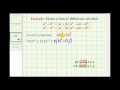
Factoring Sums and Differences of Cubes

Interactive Video
•
Mathematics
•
8th - 12th Grade
•
Practice Problem
•
Hard
Standards-aligned

Ethan Morris
FREE Resource
Standards-aligned
Read more
10 questions
Show all answers
1.
MULTIPLE CHOICE QUESTION
30 sec • 1 pt
What is the main challenge in the given example of factoring a sum or difference of cubes?
The numbers are too small.
The expression involves high powers.
The expression is already factored.
The numbers are not perfect cubes.
2.
MULTIPLE CHOICE QUESTION
30 sec • 1 pt
Why is it important to factor out the greatest common factor first?
It is not important.
It simplifies the expression.
It ensures the expression is factored correctly.
It makes the numbers larger.
3.
MULTIPLE CHOICE QUESTION
30 sec • 1 pt
What is the greatest common factor of 64 and 216?
8
6
4
12
4.
MULTIPLE CHOICE QUESTION
30 sec • 1 pt
How many factors of 2 are there in the prime factorization of 64?
6
5
4
3
Tags
CCSS.HSA.APR.C.4
5.
MULTIPLE CHOICE QUESTION
30 sec • 1 pt
What is the result of factoring out the greatest common factor from the expression?
64x^3 + 216y^3
8x^6 + 27y^3
64x^6 + 216y^3
8x^3 + 27y^3
Tags
CCSS.8.EE.A.2
6.
MULTIPLE CHOICE QUESTION
30 sec • 1 pt
Why is 8x^6 considered a perfect cube?
It cannot be written as a cube.
It can be written as (8x)^3.
It can be written as (4x)^3.
It can be written as (2x^2)^3.
Tags
CCSS.6.EE.A.2C
7.
MULTIPLE CHOICE QUESTION
30 sec • 1 pt
What is the value of 'A' in the sum of cubes formula for this example?
2x
2x^2
3y^2
3y
Tags
CCSS.HSA.APR.C.4
Access all questions and much more by creating a free account
Create resources
Host any resource
Get auto-graded reports

Continue with Google

Continue with Email

Continue with Classlink

Continue with Clever
or continue with

Microsoft
%20(1).png)
Apple

Others
Already have an account?

