
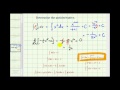
Understanding Anti-Derivatives and Integration

Interactive Video
•
Mathematics
•
9th - 12th Grade
•
Practice Problem
•
Hard

Lucas Foster
FREE Resource
Read more
10 questions
Show all answers
1.
MULTIPLE CHOICE QUESTION
30 sec • 1 pt
Why can't the power rule be directly applied to find the anti-derivative of 1/x^6?
Because the power rule only applies to polynomials
Because x^6 is in the denominator
Because 1/x^6 is not a function
Because the power rule requires a constant term
2.
MULTIPLE CHOICE QUESTION
30 sec • 1 pt
What is the first step in rewriting 1/x^6 to apply the power rule?
Factor out a constant
Add a constant term
Rewrite it as x^-6
Multiply by x^6
3.
MULTIPLE CHOICE QUESTION
30 sec • 1 pt
After applying the power rule to x^-6, what is the resulting expression before simplification?
x^-5 / -5 + C
x^-7 / -7 + C
x^-6 / -6 + C
x^-4 / -4 + C
4.
MULTIPLE CHOICE QUESTION
30 sec • 1 pt
What is the purpose of differentiating the result after finding an anti-derivative?
To simplify the expression further
To find the constant of integration
To verify the correctness of the anti-derivative
To check if the result is a polynomial
5.
MULTIPLE CHOICE QUESTION
30 sec • 1 pt
What function is used to find the anti-derivative of 1/x?
Exponential function
Quadratic function
Natural logarithm function
Trigonometric function
6.
MULTIPLE CHOICE QUESTION
30 sec • 1 pt
How is the constant 3 handled when finding the anti-derivative of 3/x?
It is ignored
It is added to the result
It is factored out of the integral
It is multiplied by x
7.
MULTIPLE CHOICE QUESTION
30 sec • 1 pt
What happens if you incorrectly apply the power rule to the integral of 1/x?
You simplify the expression
You get a correct result
You divide by zero
You find a new function
Access all questions and much more by creating a free account
Create resources
Host any resource
Get auto-graded reports

Continue with Google

Continue with Email

Continue with Classlink

Continue with Clever
or continue with

Microsoft
%20(1).png)
Apple

Others
Already have an account?

