
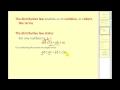
Combining Like Terms and Distributive Law

Interactive Video
•
Mathematics
•
6th - 8th Grade
•
Practice Problem
•
Hard
+1
Standards-aligned

Ethan Morris
FREE Resource
Standards-aligned
Read more
10 questions
Show all answers
1.
MULTIPLE CHOICE QUESTION
30 sec • 1 pt
What are like terms?
Terms with different variable parts
Terms with the same coefficients
Terms with the same variable parts
Terms with different coefficients
Tags
CCSS.6.EE.A.2B
2.
MULTIPLE CHOICE QUESTION
30 sec • 1 pt
Which of the following pairs are unlike terms?
7x and 3x^2
5 and 8
2y and -4y
3x and 5x
Tags
CCSS.6.EE.A.3
3.
MULTIPLE CHOICE QUESTION
30 sec • 1 pt
What does the distributive law state?
a * (b + c) = a + b + c
a * (b + c) = ab + ac
a + b = b + a
a * b = b * a
Tags
CCSS.7.EE.A.1
4.
MULTIPLE CHOICE QUESTION
30 sec • 1 pt
How can you combine like terms using the distributive property?
By factoring out the common variable part and adding the coefficients
By adding the coefficients and changing the variable part
By multiplying the coefficients and the variable part
By subtracting the coefficients and keeping the variable part
Tags
CCSS.7.EE.A.1
5.
MULTIPLE CHOICE QUESTION
30 sec • 1 pt
What is the result of combining 5x and 8x?
13x
3x
40x
5x + 8x
Tags
CCSS.7.EE.A.1
6.
MULTIPLE CHOICE QUESTION
30 sec • 1 pt
When combining like terms, what happens to the variable part?
It changes to match the largest term
It is removed
It is multiplied by the coefficients
It stays the same
Tags
CCSS.7.EE.A.1
7.
MULTIPLE CHOICE QUESTION
30 sec • 1 pt
What is the simplified form of 21c - 2c?
-2c
21c
19c
23c
Tags
CCSS.7.EE.A.1
Access all questions and much more by creating a free account
Create resources
Host any resource
Get auto-graded reports

Continue with Google

Continue with Email

Continue with Classlink

Continue with Clever
or continue with

Microsoft
%20(1).png)
Apple

Others
Already have an account?

