
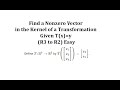
Understanding the Kernel of a Transformation

Interactive Video
•
Mathematics
•
10th - 12th Grade
•
Practice Problem
•
Hard
Standards-aligned

Jackson Turner
FREE Resource
Standards-aligned
Read more
9 questions
Show all answers
1.
MULTIPLE CHOICE QUESTION
30 sec • 1 pt
What is the transformation T from R3 to R2 defined as?
T(x1, x2, x3) = (x1, x2)
T(x1, x2, x3) = (x3, x1)
T(x1, x2, x3) = (x2, x3)
T(x1, x2, x3) = (x1, x3)
Tags
CCSS.8.F.A.1
CCSS.HSF.IF.A.1
2.
MULTIPLE CHOICE QUESTION
30 sec • 1 pt
What does the kernel of a transformation represent?
The set of all vectors in R2
The set of all non-zero vectors
The set of all input vectors that map to the zero vector
The set of all output vectors
Tags
CCSS.8.EE.C.8B
3.
MULTIPLE CHOICE QUESTION
30 sec • 1 pt
Which components of the vector must be zero for it to be in the kernel of T?
x1 and x3
x2 and x3
x1, x2, and x3
x1 and x2
4.
MULTIPLE CHOICE QUESTION
30 sec • 1 pt
What can be said about the component x2 in the kernel of T?
x2 must be zero
x2 must be negative
x2 can be any real number
x2 must be positive
5.
MULTIPLE CHOICE QUESTION
30 sec • 1 pt
What is the general form of vectors in the kernel of T?
(0, 0, t)
(t, 0, t)
(0, t, 0)
(t, t, 0)
6.
MULTIPLE CHOICE QUESTION
30 sec • 1 pt
What does the vector (0, 1, 0) represent in the context of the kernel of T?
A zero vector
A vector not in the kernel
A non-zero vector in the kernel
A vector in R2
7.
MULTIPLE CHOICE QUESTION
30 sec • 1 pt
How can we find a non-zero vector in the kernel of T?
By setting x2 to zero
By setting x2 to any non-zero value
By setting x1 to any non-zero value
By setting x1 and x3 to any value
Access all questions and much more by creating a free account
Create resources
Host any resource
Get auto-graded reports

Continue with Google

Continue with Email

Continue with Classlink

Continue with Clever
or continue with

Microsoft
%20(1).png)
Apple

Others
Already have an account?

