
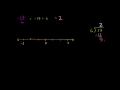
Understanding Negative Fractions and Mixed Numbers

Interactive Video
•
Mathematics
•
6th - 8th Grade
•
Practice Problem
•
Hard
+4
Standards-aligned

Aiden Montgomery
FREE Resource
Standards-aligned
Read more
10 questions
Show all answers
1.
MULTIPLE CHOICE QUESTION
30 sec • 1 pt
What is the first step in determining where negative 17/6 should be placed on a number line?
Add 17 to 6
Multiply by 6
Convert it to a mixed number
Convert it to a decimal
Tags
CCSS.3.NF.A.1
CCSS.3.NF.A.2B
2.
MULTIPLE CHOICE QUESTION
30 sec • 1 pt
When dividing 17 by 6, how many times does 6 go into 17?
3 times
2 times
4 times
1 time
Tags
CCSS.4.NBT.B.6
3.
MULTIPLE CHOICE QUESTION
30 sec • 1 pt
What is the remainder when 17 is divided by 6?
6
1
2
5
Tags
CCSS.3.OA.A.2
4.
MULTIPLE CHOICE QUESTION
30 sec • 1 pt
What is the significance of the remainder in the division process?
It determines the whole number part
It is ignored in the final answer
It forms the fractional part of the mixed number
It is added to the divisor
5.
MULTIPLE CHOICE QUESTION
30 sec • 1 pt
What is the mixed number form of negative 17/6?
Negative 2 and 1/6
Negative 2 and 5/6
Negative 3 and 5/6
Negative 3 and 1/6
6.
MULTIPLE CHOICE QUESTION
30 sec • 1 pt
Why is it helpful to convert an improper fraction to a mixed number?
It makes addition easier
It is required for subtraction
It simplifies multiplication
It helps in plotting on a number line
Tags
CCSS.6.NS.C.6C
7.
MULTIPLE CHOICE QUESTION
30 sec • 1 pt
How many marks are there between negative 3 and positive 3 on the number line?
6 marks
5 marks
7 marks
8 marks
Tags
CCSS.6.NS.C.6C
Access all questions and much more by creating a free account
Create resources
Host any resource
Get auto-graded reports

Continue with Google

Continue with Email

Continue with Classlink

Continue with Clever
or continue with

Microsoft
%20(1).png)
Apple

Others
Already have an account?

