
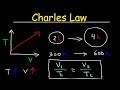
Understanding Charles's Law

Interactive Video
•
Physics, Science
•
7th - 10th Grade
•
Practice Problem
•
Easy

Mia Campbell
Used 14+ times
FREE Resource
Read more
10 questions
Show all answers
1.
MULTIPLE CHOICE QUESTION
30 sec • 1 pt
What does Charles's Law describe?
The relationship between pressure and temperature
The relationship between volume and temperature
The relationship between pressure and volume
The relationship between mass and volume
2.
MULTIPLE CHOICE QUESTION
30 sec • 1 pt
According to Charles's Law, what happens to the volume of a gas if the temperature increases?
The volume decreases
The volume fluctuates
The volume increases
The volume remains constant
3.
MULTIPLE CHOICE QUESTION
30 sec • 1 pt
What is the formula associated with Charles's Law?
P1*V1 = P2*V2
V1*P1 = V2*P2
V1/T1 = V2/T2
P1/T1 = P2/T2
4.
MULTIPLE CHOICE QUESTION
30 sec • 1 pt
In the first example problem, what is the new volume when the temperature is increased to 400 Kelvin?
3.5 liters
4.5 liters
5.6 liters
6.5 liters
5.
MULTIPLE CHOICE QUESTION
30 sec • 1 pt
Why is it important to use Kelvin instead of Celsius in Charles's Law calculations?
Kelvin is a more common unit
Kelvin is a larger unit
Kelvin provides a direct proportionality
Kelvin is easier to calculate
6.
MULTIPLE CHOICE QUESTION
30 sec • 1 pt
In the second example, what is the Kelvin temperature equivalent of 25 degrees Celsius?
298 Kelvin
323 Kelvin
250 Kelvin
273 Kelvin
7.
MULTIPLE CHOICE QUESTION
30 sec • 1 pt
What is the new volume of the balloon when the temperature is increased to 50 degrees Celsius in the second example?
298 milliliters
350 milliliters
323 milliliters
275 milliliters
Access all questions and much more by creating a free account
Create resources
Host any resource
Get auto-graded reports

Continue with Google

Continue with Email

Continue with Classlink

Continue with Clever
or continue with

Microsoft
%20(1).png)
Apple

Others
Already have an account?

