
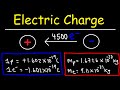
Electric Charge and Conservation Principles

Interactive Video
•
Physics, Chemistry, Science
•
9th - 12th Grade
•
Practice Problem
•
Hard

Jackson Turner
FREE Resource
Read more
10 questions
Show all answers
1.
MULTIPLE CHOICE QUESTION
30 sec • 1 pt
What is the charge of one electron?
1.602 x 10^-19 coulombs
-1.602 x 10^-19 coulombs
1.602 x 10^19 coulombs
-1.602 x 10^19 coulombs
2.
MULTIPLE CHOICE QUESTION
30 sec • 1 pt
How many electrons are transferred to a neutral metal rod to give it a charge of -7.2 x 10^-16 coulombs?
4500 electrons
3500 electrons
5000 electrons
4000 electrons
3.
MULTIPLE CHOICE QUESTION
30 sec • 1 pt
What is Avogadro's number?
6.022 x 10^-23
6.022 x 10^-19
6.022 x 10^19
6.022 x 10^23
4.
MULTIPLE CHOICE QUESTION
30 sec • 1 pt
What is the total electric charge of 3.6 moles of electrons?
-347,000.3 coulombs
347,000.3 coulombs
-347,000.3 kilocoulombs
347,000.3 kilocoulombs
5.
MULTIPLE CHOICE QUESTION
30 sec • 1 pt
What is the charge of one proton?
1.602 x 10^19 coulombs
-1.602 x 10^-19 coulombs
-1.602 x 10^19 coulombs
1.602 x 10^-19 coulombs
6.
MULTIPLE CHOICE QUESTION
30 sec • 1 pt
How is the electric charge of 50 kg of protons calculated?
By using the volume of protons
By using the mass of a proton and its charge
By using the number of moles and Avogadro's number
By using the charge of an electron
7.
MULTIPLE CHOICE QUESTION
30 sec • 1 pt
What happens to the charge of two identical metal spheres when they are brought into contact?
The charges are halved
The charges are doubled
The charges are averaged
The charges remain the same
Access all questions and much more by creating a free account
Create resources
Host any resource
Get auto-graded reports

Continue with Google

Continue with Email

Continue with Classlink

Continue with Clever
or continue with

Microsoft
%20(1).png)
Apple

Others
Already have an account?


