
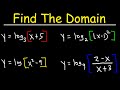
Understanding Domains of Logarithmic Functions

Interactive Video
•
Mathematics
•
8th - 12th Grade
•
Practice Problem
•
Easy

Liam Anderson
Used 1+ times
FREE Resource
Read more
10 questions
Show all answers
1.
MULTIPLE CHOICE QUESTION
30 sec • 1 pt
What must be true about the argument of a logarithmic function for it to be defined?
It can be any real number.
It must be less than zero.
It must be equal to zero.
It must be greater than zero.
2.
MULTIPLE CHOICE QUESTION
30 sec • 1 pt
For the function log base 3 of (x + 5), what is the domain?
x < -5
x = -5
x > -5
x ≥ -5
3.
MULTIPLE CHOICE QUESTION
30 sec • 1 pt
How do you determine the domain of a function like log base 3 of (3x - 5)?
Set 3x - 5 equal to zero.
Set 3x - 5 greater than zero.
Set 3x - 5 less than zero.
Set 3x - 5 not equal to zero.
4.
MULTIPLE CHOICE QUESTION
30 sec • 1 pt
What is the domain of the function log base 3 of (4 - 2/3x)?
x = 6
x > 6
x < 6
x ≤ 6
5.
MULTIPLE CHOICE QUESTION
30 sec • 1 pt
When factoring x^2 - 9 in a logarithmic function, what values must be excluded from the domain?
x = 9 and x = -9
x = 3 and x = -3
x = 0 and x = 9
x = 0 and x = -9
6.
MULTIPLE CHOICE QUESTION
30 sec • 1 pt
For the function log base 2 of (x - 1)^2, what is the domain?
x < 1
x > 1
x ≠ 1
x = 1
7.
MULTIPLE CHOICE QUESTION
30 sec • 1 pt
In the function log base 7 of (x^2 - 4x), which values of x are not allowed?
x = 0 and x = 4
x = 2 and x = -2
x = 4 and x = -4
x = 0 and x = -4
Access all questions and much more by creating a free account
Create resources
Host any resource
Get auto-graded reports

Continue with Google

Continue with Email

Continue with Classlink

Continue with Clever
or continue with

Microsoft
%20(1).png)
Apple

Others
Already have an account?

