
Radical Inequalities and Their Solutions

Interactive Video
•
Mathematics, Education
•
8th - 10th Grade
•
Practice Problem
•
Hard

Ethan Morris
FREE Resource
Read more
10 questions
Show all answers
1.
MULTIPLE CHOICE QUESTION
30 sec • 1 pt
What is a key restriction when dealing with square roots in radical inequalities?
The radicand must be zero.
The radicand must be positive.
The radicand can be any real number.
The radicand must be negative.
2.
MULTIPLE CHOICE QUESTION
30 sec • 1 pt
In the first example, what is the solution set for the inequality \( \sqrt{3x + 3} \leq 6 \)?
[-1, ∞)
(-∞, -1]
[-1, 11]
[0, 11]
3.
MULTIPLE CHOICE QUESTION
30 sec • 1 pt
What is the first step in solving a radical inequality with a non-isolated radical?
Isolate the radical.
Set the inequality to zero.
Add a constant to both sides.
Multiply both sides by a constant.
4.
MULTIPLE CHOICE QUESTION
30 sec • 1 pt
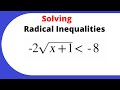
In the second example, what is the solution set for the inequality \( -2\sqrt{x + 1} < -8 \)?
[15, ∞)
(-∞, 15)
(-∞, 15]
(15, ∞)
5.
MULTIPLE CHOICE QUESTION
30 sec • 1 pt
What is the solution set for the inequality \( \sqrt{2x + 1} \geq -4 \)?
[-1/2, ∞)
(-∞, 7.5]
[7.5, ∞)
(-∞, -1/2]
6.
MULTIPLE CHOICE QUESTION
30 sec • 1 pt
In the third example, what is the solution set for the inequality \( 9 \geq 5 + \sqrt{x - 2} \)?
[2, 18)
(2, 18]
[2, 18]
(2, 18)
7.
MULTIPLE CHOICE QUESTION
30 sec • 1 pt
How does the handling of cube roots differ from square roots in radical inequalities?
Cube roots must have zero as the radicand.
Cube roots must have negative radicands.
Cube roots can have any real number as the radicand.
Cube roots can only have positive radicands.
Access all questions and much more by creating a free account
Create resources
Host any resource
Get auto-graded reports

Continue with Google

Continue with Email

Continue with Classlink

Continue with Clever
or continue with

Microsoft
%20(1).png)
Apple

Others
Already have an account?


