
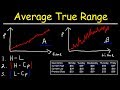
Understanding Average True Range (ATR)

Interactive Video
•
Mathematics, Business
•
9th - 12th Grade
•
Practice Problem
•
Hard

Aiden Montgomery
FREE Resource
Read more
10 questions
Show all answers
1.
MULTIPLE CHOICE QUESTION
30 sec • 1 pt
What does the Average True Range (ATR) measure?
Market trend
Market volatility
Trading volume
Price direction
2.
MULTIPLE CHOICE QUESTION
30 sec • 1 pt
Which of the following is NOT a formula used to calculate the True Range?
Current close minus previous open
Current low minus previous close
Current high minus previous close
Current high minus current low
3.
MULTIPLE CHOICE QUESTION
30 sec • 1 pt
In the example provided, what was the True Range for Monday?
$4
$3
$1
$2
4.
MULTIPLE CHOICE QUESTION
30 sec • 1 pt
How is the Average True Range (ATR) calculated over a period?
Sum of high prices divided by the number of days
Sum of low prices divided by the number of days
Sum of closing prices divided by the number of days
Sum of True Ranges divided by the number of days
5.
MULTIPLE CHOICE QUESTION
30 sec • 1 pt
Which stock chart would likely have a higher ATR value?
A chart with small daily price changes
A chart with large daily price fluctuations
A chart with a steady upward trend
A chart with a steady downward trend
6.
MULTIPLE CHOICE QUESTION
30 sec • 1 pt
What does a high ATR value indicate about a stock?
Decreasing trend
High volatility
Stable price
Low volatility
7.
MULTIPLE CHOICE QUESTION
30 sec • 1 pt
In a stock chart, what does a low ATR value suggest?
High volatility
Decreasing trend
Low volatility
Increasing trend
Access all questions and much more by creating a free account
Create resources
Host any resource
Get auto-graded reports

Continue with Google

Continue with Email

Continue with Classlink

Continue with Clever
or continue with

Microsoft
%20(1).png)
Apple

Others
Already have an account?

