
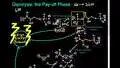
(NEW!) Glycolysis Part 3 4 The Payoff Phase

Interactive Video
•
Science, Chemistry
•
University
•
Practice Problem
•
Hard

Wayground Content
FREE Resource
Read more
10 questions
Show all answers
1.
MULTIPLE CHOICE QUESTION
30 sec • 1 pt
What is the primary reason the initial phase of glycolysis is called the 'investment phase'?
It requires an input of ATP.
It creates NADH.
It generates ATP.
It produces pyruvate.
2.
MULTIPLE CHOICE QUESTION
30 sec • 1 pt
During glycolysis, what happens to dihydroxyacetone phosphate (DHAP)?
It is used to produce ATP directly.
It is excreted from the cell.
It is converted into G3P.
It is converted into glucose.
3.
MULTIPLE CHOICE QUESTION
30 sec • 1 pt
How many G3P molecules are produced from one glucose molecule during glycolysis?
Four
Three
Two
One
4.
MULTIPLE CHOICE QUESTION
30 sec • 1 pt
What is the role of G3P dehydrogenase in glycolysis?
It converts glucose to pyruvate.
It removes hydrogen from G3P to form NADH.
It adds a phosphate group to glucose.
It splits glucose into two molecules.
5.
MULTIPLE CHOICE QUESTION
30 sec • 1 pt
Which molecule is directly responsible for the production of ATP in the payoff phase of glycolysis?
1,3-bisphosphoglycerate
Pyruvate
G3P
NADH
6.
MULTIPLE CHOICE QUESTION
30 sec • 1 pt
What is the significance of phosphoenolpyruvate (PEP) in glycolysis?
It is an enzyme that catalyzes the conversion of glucose.
It is a high-energy molecule that donates a phosphate to ADP.
It is the initial substrate of glycolysis.
It is the final product of glycolysis.
7.
MULTIPLE CHOICE QUESTION
30 sec • 1 pt
How many ATP molecules are produced in the conversion of phosphoenolpyruvate to pyruvate?
Three
Four
One
Two
Access all questions and much more by creating a free account
Create resources
Host any resource
Get auto-graded reports

Continue with Google

Continue with Email

Continue with Classlink

Continue with Clever
or continue with

Microsoft
%20(1).png)
Apple

Others
Already have an account?

