
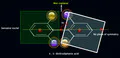
Biphenyls & Optical Isomerism: When Planes Matter

Interactive Video
•
Chemistry, Science, Physics
•
10th Grade - University
•
Practice Problem
•
Hard

Wayground Content
FREE Resource
Read more
5 questions
Show all answers
1.
MULTIPLE CHOICE QUESTION
30 sec • 1 pt
What is the reason biphenyls are generally optically inactive?
They have chiral centers.
They have a plane of symmetry.
They contain bulky groups at ortho positions.
The phenyl groups are in constant motion due to free rotation.
2.
MULTIPLE CHOICE QUESTION
30 sec • 1 pt
Under what condition do biphenyl compounds become optically active?
When they are in constant motion.
When they have no substituents.
When they have identical substituents on one benzene ring.
When bulky groups are substituted at ortho positions with different substituents.
3.
MULTIPLE CHOICE QUESTION
30 sec • 1 pt
What effect do bulky groups at ortho positions have on biphenyls?
They make the molecule planar.
They increase the free rotation of the molecule.
They create a plane of symmetry.
They restrict the rotation, leading to optical activity.
4.
MULTIPLE CHOICE QUESTION
30 sec • 1 pt
What is the term used to describe the formation of isomers due to restricted rotation in biphenyls?
Heteroisomerism
Stereoisomerism
Optical isomerism
Geometric isomerism
5.
MULTIPLE CHOICE QUESTION
30 sec • 1 pt
What is the bond angle difference between the benzene nuclei in a biphenyl molecule with restricted rotation?
60°
180°
120°
90°
Access all questions and much more by creating a free account
Create resources
Host any resource
Get auto-graded reports

Continue with Google

Continue with Email

Continue with Classlink

Continue with Clever
or continue with

Microsoft
%20(1).png)
Apple

Others
Already have an account?

